On Saturday, October 24th, I had the honor of delivering a speech before an audience gathered at
John Sevier's Marble Springs Plantation Home for "The Muster at Marble Springs." The day included living history demonstrations of life and soldiering during the War of 1812. My talk that afternoon focused on Sevier's role as a "War Hawk," advocating for a formal declaration of war against Great Britain leading up to the War of 1812.
I'm grateful to Marble Springs for extending this invitation so that I could take part in this event. I'd also like to thank my
State Library and Archives colleague, Myers Brown, for his role in organizing the day's activities. A good time was had by all, and I hope those gathered to hear my remarks enjoyed the presentation...
 |
| Marble Springs State Historic Site. Author photo. |
John Sevier: The War Hawk of 1812
Remarks delivered by Gordon T. Belt, author of John Sevier: Tennessee’s First Hero, and Director of Public Services for the Tennessee State Library and Archives
October 24, 2015
I’m honored to be here with you today at John Sevier’s Marble Springs plantation home one month to the day following the observance of the 200th anniversary of Sevier’s death.
Sevier died on September 24th, 1815 while on a surveying mission in former Creek territory – a mission sanctioned by President James Madison following Andrew Jackson’s conquest of the Creek Nation at the Battle of Horseshoe Bend – a turning point in the War of 1812.
Sevier was almost seventy years old at the time he left Marble Springs to venture forth on this journey, an advanced age for that time to risk one’s life to nature and to the elements. But Sevier did not let his advancing age deter him from this mission to survey the Creek territory. He viewed it as a moral obligation – to finish a war for which he had strongly advocated, and to claim the glory of victory that his political rival, Andrew Jackson, had earned on the field of battle.
What led Sevier to that spot of land near Fort Decatur, Alabama, where he drew his last breath in service to his nation? To answer this question, I’d like to take you back to Sevier’s waning moments as Governor of Tennessee…
After serving six successful two-year terms as Tennessee’s chief executive, Sevier’s final term as governor ended in 1809. As he bid farewell to the office of governor, his popularity among the citizenry of Tennessee remained extraordinarily high, and he had earned the respect and admiration of his constituents. Sevier campaigned for a seat in the U.S. House of Representatives and claimed victory in that campaign just as he had in all his previous political campaigns and in his military campaigns against the Cherokees. Sevier served the remainder of his political career as a congressman from 1811 until his death in 1815.
Though an effective administrator and a popular politician in Tennessee, Sevier never experienced the same level of success as a statesman in Washington, D.C. While he served on several committees early in his congressional career, Sevier at no time held a leadership role and rarely voiced his opinion on the House floor. One journalist covering Capitol Hill noted that Sevier arrived at Congress “stiff and grim as an Indian arrow, not speaking, but looking daggers.” Sevier’s biographer Carl Driver observed, “No speech is recorded, and no letters or documents are available which would indicate that [Sevier] took part in a single debate.”
Sevier openly expressed his views, however, on one issue. In 1812, members of Congress debated the prospect of military intervention against Great Britain.
This occurred in response to the British navy’s interference with trade and the impressment of sailors on American ships, as well as British military support of Indian tribes eager to halt American territorial expansion.
For years prior to a formal declaration of war, Americans grew increasingly frustrated and outraged by the British impressment of United States citizens. As early as January 1806, as Governor of Tennessee, John Sevier wrote to Senator Daniel Smith complaining about impressment and stated:
“They seize with impunity the property and person of our citizens… If the alternative be ever so disagreeable and unprofitable, there is but one resort to be had… The dignity, interest, and character of our republic… is at stake.”
The Governor promised Senator Smith that, if necessary, the Tennessee Militia would be “held in the most perfect and complete order” to respond to the British threat.
As citizens petitioned Governor Sevier in 1808 to call a special session of the legislature to deal with the problem, Governor Sevier put the state militia on alert. On January 12, 1809, Governor Sevier ordered General Andrew Jackson to place 1,000 militiamen in readiness to serve the President of the United States. A year later, in 1810, the Revolutionary War veteran Sevier predicted another war with Great Britain, admitting that, “we shall have to cope again with the old Tory party.”
Sevier’s prediction proved prophetic. A few short years later, now serving as a member of Congress, Sevier joined a group of legislators known collectively as the War Hawks, an alliance of congressmen from the south and west who argued vigorously for war against Great Britain in response to these provocations.
The War Hawks encouraged war as a means to retaliate against Britain for the economic distress caused by the blockade, and for encouraging Native American resistance to American expansion into the West. Sevier – still harboring a fierce disdain toward the British and their Indian allies – had finally found his cause. The vicious warfare Sevier had experienced earlier in life as an Indian fighter during Tennessee’s early settlement left a bitter impression on Sevier the Congressman. His constant stare, “looking daggers,” must have appeared particularly sharp at this time.
As members of Congress convened to debate the merits of war, Sevier took an active role as a supportive advocate for the cause. He led the Military Affairs Committee of the United States House of Representatives, and he frequently met with heads of state, including the Minister of France, to discuss political and military strategy. Sevier also attended dinner parties hosted by the First Lady, Dolly Madison. Of course, the topic of conversation at these dinner parties usually revolved around the war with Great Britain. Sevier used these occasions to engage with government leaders and foreign diplomats, and to secure their support for the war effort. These connections kept Sevier actively engaged in the war, even though he never fought in the field of battle. Though he surely longed to draw his sword in defense of the nation, his pen and paper served as his sword and shield throughout the War of 1812.
Sevier maintained constant communication with Tennesseans involved in the war effort through his letters and correspondence. He was particularly concerned with keeping his son, George Washington Sevier, informed about military affairs. George lived in the Mississippi Territory at the time, serving as a captain in the United States Army. George’s close proximity to the land occupied by the native tribes of the region deeply troubled Sevier, who expressed a fatherly concern over his son’s well being in a letter, dated January 13, 1812. He wrote:
“My Dear Son… I have lost one son among the savages, and I am unwilling to trust another whom you know I much regard.— I should be very unwilling to see you and your beautiful young growing family Settled in the midst of a Savage nation— Your prospects in the Army are good, and you are entitled to promotion, and war being almost sure to commence immediately, it would be improper for you to resign.”
Sevier urged his son to continue his military career. By doing so, he would most assuredly guarantee himself a promotion to a high rank, and perhaps avoid the dangers of living among the “savages.”
Sevier continued in his letter to describe how the war was playing out in the halls of Congress. He wrote to his son with conviction, believing that the coming war was a just cause worth the fight:
“We are taking decided measures in Congress,” Sevier wrote. “We have passed the first law to fill up and complete the present peace establishment, and the second to raise an additional army of twenty five thousand Regular troops, to serve five years, at the end of which they are to receive three months extra pay and 160 acres of land — we shall also pass a law authorizing the President to accept the services of fifty thousand volunteers — Canada will be the object — Our Government has tried negotiation until it is exhausted, and there is no doubt in my mind the Executive has observed the most perfect uprightness, and impartial neutrality.”
The pages of Sevier’s letter seared with contempt and frustration towards the British with each stroke of the pen. He wrote:
“The British take every one of our vessels they come across that is bound into any other port besides one of their own — They lately condemned and sold at one time no less than 54 vessels and cargoes all richly laden, and so they have been going on for years. Two well informed gentlemen were with me several days at our lodgings… They were in France and England, the latter they left about the first of the last month & in which place they never heard America spoken of but with contempt; and themselves often treated with great contempt on account of their Country.”
The following March, Sevier wrote again to his son, George, concerning the events of the day. He delivered the news that Congress and his fellow War Hawks continued to galvanize behind a formal declaration of war. “We are still going on with War Measures, and no doubt there will be one,” he wrote.
In his letter to his son, Sevier also claimed to have documented proof of a plot by British officials to divide the nation politically and militarily. He called it “an explosion of a British conspiracy” in which he alleged that the British employed the Governor General of Canada, and other officers, to “bring about a severance of the union, by separating the Northern from the Southern States.” Sevier described the plot as “a most abominable piece of corruption and villainy.”
In April of 1812, Sevier again wrote to his son George, describing the events in Washington as they unfolded. He described the political mood shifting with the winds of war. “The federal party here are a very artfull designing set, and are frequently trying to create divisions in the other side of the House, but I believe that the stand is so firmly taken, that all their efforts will be in vain…” He further declared:
“…I don't conceive there can be a shadow of doubt remaining of War; we have had news from England as late as the 20th of March, and no appearance of any relaxation of their measures towards America; therefore one of two things, either War or Submission…”
Sevier then paused to reflect on what the country may face once Congress declared its war against Great Britain. “We may look for hot times, for the British are inevitably strong,” he wrote, “and I fear stronger than at the beginning of the Revolution.” Age and experience had, perhaps, tempered Sevier’s enthusiasm for bloodshed, but he remained unwavering in his commitment to the cause of war.
On eleven separate war measures considered by the House of Representatives, Sevier voted in favor of all but one. His single “NO” vote – a resolution to levy a tax of 20 cents a bushel on imported salt to fund the war effort – resulted in a second vote on a similar resolution to reconsider the tax – a tax for which Sevier ultimately reversed course and voted in favor of the measure.
Finally, on June 4, 1812, Sevier joined seventy-eight of his congressional colleagues and voted for a formal declaration of war. In a letter written to Tennessee Governor Willie Blount following the vote, Sevier conveyed his feelings on the matter. He declared, “We have at length passed the Rubicon. War is finally declared against Britain and her dependencies.”
Sevier’s letter burned with hatred toward the enemy, especially the Creek Indians, whom he believed the British supported:
“Fire and sword must be carried into that country before those wretches will be reduced to reason or become peaceable neighbors… There can be no reliance or trust placed in them. No doubt British emissaries are among them.”
Sevier echoed these sentiments in another letter to his son, George, to whom he wrote, “There is not the least confidence to be placed in savages… I would not trust neither Chickasaws, nor Cherokees too far.” As for the Creeks, Sevier summed up his attitude by declaring them “as great a set of villains as ever lived.” By the end of this momentous day, Sevier retired to his diary and described June 4th, 1812 as a “Pleasant day” – clearly pleased with the outcome of the vote to declare war against Great Britain over sailor’s rights and British support of the western frontier tribes. Following the Senate's vote to pass the War Bill, President Madison quickly signed the measure into law, and the nation found itself, once again, at war with Great Britain.
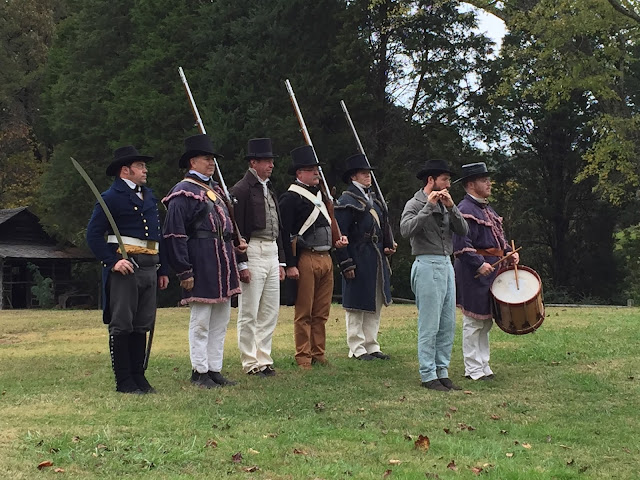 |
| Living history on display during the War of 1812 Muster at Marble Springs. Author photo. |
With the war engaged, Sevier’s thoughts turned again toward his son, George. After learning that George had come down with a case of rheumatism, Sevier pleaded with his son to return home. “I wish you could spend a summer at Marble Springs,” he wrote, “probably the Water would relieve you, as it has done me — I am very confident it was that water alone that gave me any relief.” Sevier also expressed a growing concern over George and his family’s safety, living on the far reaches of the American frontier. “The Indians are doing much damage on the frontiers everywhere,” he wrote. “I hope you will prepare for the worst. Your station is much exposed, you can’t be too cautious.”
At the onset of the war, the theater of operations concentrated on the Canadian-American border. Tennesseans, eager to fight, offered their services to the government; but distance prevented the state’s citizens from making any direct contribution. However, when President James Madison called on Tennessee to help defend the "Lower Country," Tennesseans volunteered en masse, earning Tennessee the nickname "The Volunteer State." Sevier reported to his son, George: “The Militia are turning out everywhere with great alacrity, and also the recruiting service is going on very briskly.”
Governor Blount was asked to send 1,500 troops for the defense of the lower Mississippi region and an expedition under the command of Andrew Jackson was outfitted in December 1812. The theater of war quickly spread south, toward Florida, and into Creek Territory, where General Jackson ultimately carried “Fire and Sword” to that country at the Battle of Horseshoe Bend.
Meanwhile, back in Washington, D.C., Sevier and his fellow members of Congress struggled with what to do in the aftermath of a devastating attack on our nation’s capital. In August of 1814, the British burned Washington to the ground. The government was in disarray.
In the months that followed, Sevier noted in his diary that the House of Representatives “negotiated a bill for the removal of the seat of Government” following the burning of Washington. And as the 13th Congress returned to Washington, they convened in makeshift quarters at the Patent Office and at other locations throughout the district to conduct their legislative business, while workers toiled to resurrect the capital from the ashes.
On Christmas Eve, 1814, after months of negotiations, British and American diplomats signed the Treaty of Ghent, restoring relations between the two nations to the status quo, before the war started – in essence, ending the War of 1812 in a stalemate. News of the treaty signing didn’t reach American shores until early the following year, and the Senate didn’t approve the treaty until February of 1815. It was during this intervening period that Andrew Jackson marched his troops to New Orleans to claim victory at the Battle of New Orleans, thus giving Americans a victory in the war against Great Britain, all during a time of negotiated peace.
Following General Jackson’s decisive victories in the Creek War and the Battle of New Orleans, Americans expressed overwhelming jubilation over the outcome. Sevier’s nephew, Ensign John Sevier of the Seventh U.S. Infantry, flaunted his exaltation in a January 10, 1815, letter to his mother. “I feel young and active and handsome…” He wrote. “I believe we in the South have settled the dispute of Nations.” In Congress, members congratulated the Tennessee delegation. It was “as though we had been in the action,” Sevier wrote. On this occasion, Sevier penned another letter to his son, George, this time expressing his pride in what had been accomplished. He wrote: “Our army from Tennessee is more talked of here than half the world besides.”
As the nation celebrated, President Madison appointed Sevier as a commissioner to run the boundary line of the conquered Creek Nation. Sevier dutifully accepted this mission and departed this very plantation on June 10th, 1815 to begin what would become his final campaign.
 |
| Marble Springs State Historic Site. Author photo. |
As Sevier surveyed the landscape, his mind and body grew weary of the journey that had taken him from his beloved Marble Springs home. In his diary, Sevier noted, “Some unwell with pain in my back” and he later observed that one of his traveling companions, a man named Dicky Brown, became “very sick.”
In the days that followed, Sevier himself contracted a fever. Still, he found the strength to attend a feast of the Indians known as the “Green Corn Dance,” and although approaching his seventh decade of life, Sevier eagerly participated in the ceremony, feeling briefly rejuvenated by the festivities.
The next day, however, while on his return to Fort Decatur, Sevier’s health suddenly took a turn for the worse. Realizing he may be nearing death, Sevier had asked his men to carry him across the river to a spring located about a mile away and let him get a drink of water. He had hoped that the cool spring water would restore his health. Unfortunately, Sevier never made it to that spring alive.
Legend asserts that Sevier died as his men carried him across that river on September 24th, 1815. Honoring his final wish, the Sevier’s companions transported his body to a hill overlooking the spring and buried him there with full military honors. A simple two-foot-long oak stump charred at its end marked his grave until a proper grave marker could be installed on that remote spot of land.
Unaware of Sevier’s illness, Tennesseans had just reelected him to Congress without opposition. News of his death, however, quickly spread to the state capitol where members of the Tennessee General Assembly mourned their fallen hero. On October 26th, 1815, legislators passed a resolution requiring each member of the General Assembly wear a crepe on the left arm for thirty days “in honor to the memory of that distinguished fellow citizen, statesman, and patriot.”
Years after his death, the Daily Picayune newspaper of New Orleans observed that those cool spring waters “still sing a constant requiem near his grave.” Seven decades passed before Sevier’s descendants and loyal admirers saw fit to deliver his body back home to native soil, on the grounds of the Old Knox County Courthouse, where his remains now rest beneath “a cenotaph worthy” of the memory of his achievements.
As we remember Sevier’s role in the War of 1812, I’d like to conclude my remarks with a quote from my book, John Sevier: Tennessee’s First Hero. On June 19th, 1889, the Reverend Dr. James Park delivered a closing prayer during Sevier’s reinterment ceremonies here in Knoxville. On that occasion, the Reverend observed:
“Here, with patriotic pride in his heroic days in time of war, and profound veneration for his high service in time of peace, we commit his mortal remains to the grave, ‘earth to earth, ashes to ashes, and dust to dust.’ And may the people of this great State who owe so much to John Sevier for his unselfish service in times that tried men’s souls, do him justice, and yourselves and the commonwealth honor by erecting such a monument as shall keep his name and fame an illustrious example in everlasting memory.”
 Gordon Belt is an information
professional, archives advocate, public historian, and author of The History
Press book, John
Sevier: Tennessee's First Hero, which examines the life of Tennessee's
first governor, John Sevier, through the lens of history and memory.
On The Posterity Project, Gordon offers reflections on
archives, public history, and memory from his home state of Tennessee.
Gordon Belt is an information
professional, archives advocate, public historian, and author of The History
Press book, John
Sevier: Tennessee's First Hero, which examines the life of Tennessee's
first governor, John Sevier, through the lens of history and memory.
On The Posterity Project, Gordon offers reflections on
archives, public history, and memory from his home state of Tennessee.


