Showing posts with label Sevier Memory. Show all posts

John Sevier and the Road to Statehood...

On June 1, 1796, Tennessee was admitted to the Union as the 16th state, the first state created from territory that had been under federal jurisdiction. The road to statehood was marked with many obstacles, and our state's first governor, John Sevier, played a significant role in navigating each one of them. You cannot travel this road, historically speaking, without encountering John Sevier.

On June 2nd on this 222nd anniversary of Tennessee's statehood, I had the high honor of presenting a lecture at my workplace for our annual Statehood Day celebration, this year focusing on Tennessee’s first governor John Sevier. I discussed how Tennessee became a state and the prominent role Sevier played in Tennessee's early history.

I am grateful for the opportunity to share this story. I received a warm reception, a kind and generous introduction by the president of our "Friends of the Library" group, and lots of interesting questions and positive feedback from the audience following my presentation.

Here are a few images from the day, some courtesy of the Friends of the Library organization, including a peek at all three of Tennessee's State Constitutions, which were on display to the public together for only the third time in our state's history. It was truly a historic occasion, and I was honored to have a part in it.


If you're interested in scheduling a lecture or book signing with us, we'd love to hear from you. Please visit the "Events & Appearances" section of this blog for more information.


Gordon Belt is an information professional, archives advocate, public historian, and author of The History Press book, John Sevier: Tennessee's First Hero, which examines the life of Tennessee's first governor, John Sevier, through the lens of history and memory. On The Posterity Project, Gordon offers reflections on archives, public history, and memory from his home state of Tennessee.

An interview with Pat Nolan on INSIDE POLITICS...

On Friday, August 19th, I had the opportunity to chat with Pat Nolan for an interview that aired on NewsChannel5+ later that evening. In that interview, Pat and I talked about 'John Sevier: Tennessee's First Hero' and how writers viewed his life through the lens of history and memory.


Pat Nolan, NewsChannel5 Political Analyst, hosts INSIDE POLITICS, a weekly political interview show, and CAPITOL VIEW, a weekly on-line political commentary, airing on NewsChannel5+ and online. A friend and colleague pointed out to me that Pat is also the former president of the Friends of the Nashville Metro Archives, and he has spoken at Society of Tennessee Archivists annual meeting.

I'm honored by the kind words Pat shared with me after the interview...

"Thanks for coming on the show, Gordon! You've written a fascinating book about a legendary and critically important person in Tennessee's early history as well as how John Sevier's legacy has waxed and waned in the public's mind over the last two centuries."

I'm grateful to have had the opportunity to meet Pat and to have had this conversation. I'm also grateful to my Library & Archives colleague, Blake Fontenay, who arranged this interview along with NewsChannel5's Executive Director Rick Casebeer. Research gathered at the Tennessee State Library & Archives played a crucial role in the telling of this story, so I'm always happy to return the favor as an advocate for this venerable institution.

And now, I'm happy to share our interview with you here on The Posterity Project. The interview airs in three parts. Visit the NewsChannel5 website to view our conversation HERE.


Gordon Belt is an information professional, archives advocate, public historian, and author of The History Press book, John Sevier: Tennessee's First Hero, which examines the life of Tennessee's first governor, John Sevier, through the lens of history and memory. On The Posterity Project, Gordon offers reflections on archives, public history, and memory from his home state of Tennessee.

"Either War or Submission." John Sevier, the War Hawk of 1812

   On Saturday, October 24th, I had the honor of delivering a speech before an audience gathered at John Sevier's Marble Springs Plantation Home for "The Muster at Marble Springs." The day included living history demonstrations of life and soldiering during the War of 1812. My talk that afternoon focused on Sevier's role as a "War Hawk," advocating for a formal declaration of war against Great Britain leading up to the War of 1812.

   I'm grateful to Marble Springs for extending this invitation so that I could take part in this event. I'd also like to thank my State Library and Archives colleague, Myers Brown, for his role in organizing the day's activities. A good time was had by all, and I hope those gathered to hear my remarks enjoyed the presentation...

Marble Springs State Historic Site. Author photo.


John Sevier: The War Hawk of 1812


Remarks delivered by Gordon T. Belt, author of John Sevier: Tennessee’s First Hero, and Director of Public Services for the Tennessee State Library and Archives

October 24, 2015

   I’m honored to be here with you today at John Sevier’s Marble Springs plantation home one month to the day following the observance of the 200th anniversary of Sevier’s death.

   Sevier died on September 24th, 1815 while on a surveying mission in former Creek territory – a mission sanctioned by President James Madison following Andrew Jackson’s conquest of the Creek Nation at the Battle of Horseshoe Bend – a turning point in the War of 1812.

   Sevier was almost seventy years old at the time he left Marble Springs to venture forth on this journey, an advanced age for that time to risk one’s life to nature and to the elements. But Sevier did not let his advancing age deter him from this mission to survey the Creek territory. He viewed it as a moral obligation – to finish a war for which he had strongly advocated, and to claim the glory of victory that his political rival, Andrew Jackson, had earned on the field of battle.

   What led Sevier to that spot of land near Fort Decatur, Alabama, where he drew his last breath in service to his nation? To answer this question, I’d like to take you back to Sevier’s waning moments as Governor of Tennessee…

   After serving six successful two-year terms as Tennessee’s chief executive, Sevier’s final term as governor ended in 1809. As he bid farewell to the office of governor, his popularity among the citizenry of Tennessee remained extraordinarily high, and he had earned the respect and admiration of his constituents. Sevier campaigned for a seat in the U.S. House of Representatives and claimed victory in that campaign just as he had in all his previous political campaigns and in his military campaigns against the Cherokees. Sevier served the remainder of his political career as a congressman from 1811 until his death in 1815.

   Though an effective administrator and a popular politician in Tennessee, Sevier never experienced the same level of success as a statesman in Washington, D.C. While he served on several committees early in his congressional career, Sevier at no time held a leadership role and rarely voiced his opinion on the House floor. One journalist covering Capitol Hill noted that Sevier arrived at Congress “stiff and grim as an Indian arrow, not speaking, but looking daggers.” Sevier’s biographer Carl Driver observed, “No speech is recorded, and no letters or documents are available which would indicate that [Sevier] took part in a single debate.”

   Sevier openly expressed his views, however, on one issue. In 1812, members of Congress debated the prospect of military intervention against Great Britain. This occurred in response to the British navy’s interference with trade and the impressment of sailors on American ships, as well as British military support of Indian tribes eager to halt American territorial expansion.

   For years prior to a formal declaration of war, Americans grew increasingly frustrated and outraged by the British impressment of United States citizens. As early as January 1806, as Governor of Tennessee, John Sevier wrote to Senator Daniel Smith complaining about impressment and stated:

“They seize with impunity the property and person of our citizens… If the alternative be ever so disagreeable and unprofitable, there is but one resort to be had… The dignity, interest, and character of our republic… is at stake.”

   The Governor promised Senator Smith that, if necessary, the Tennessee Militia would be “held in the most perfect and complete order” to respond to the British threat.

   As citizens petitioned Governor Sevier in 1808 to call a special session of the legislature to deal with the problem, Governor Sevier put the state militia on alert. On January 12, 1809, Governor Sevier ordered General Andrew Jackson to place 1,000 militiamen in readiness to serve the President of the United States. A year later, in 1810, the Revolutionary War veteran Sevier predicted another war with Great Britain, admitting that, “we shall have to cope again with the old Tory party.”

   Sevier’s prediction proved prophetic. A few short years later, now serving as a member of Congress, Sevier joined a group of legislators known collectively as the War Hawks, an alliance of congressmen from the south and west who argued vigorously for war against Great Britain in response to these provocations.

A British frigate pursuing an American schooner.
Illustration courtesy of the Tennessee State Library and Archives, "Answering the Call: Tennesseans in the War of 1812"


   The War Hawks encouraged war as a means to retaliate against Britain for the economic distress caused by the blockade, and for encouraging Native American resistance to American expansion into the West. Sevier – still harboring a fierce disdain toward the British and their Indian allies – had finally found his cause. The vicious warfare Sevier had experienced earlier in life as an Indian fighter during Tennessee’s early settlement left a bitter impression on Sevier the Congressman. His constant stare, “looking daggers,” must have appeared particularly sharp at this time.

   As members of Congress convened to debate the merits of war, Sevier took an active role as a supportive advocate for the cause. He led the Military Affairs Committee of the United States House of Representatives, and he frequently met with heads of state, including the Minister of France, to discuss political and military strategy. Sevier also attended dinner parties hosted by the First Lady, Dolly Madison. Of course, the topic of conversation at these dinner parties usually revolved around the war with Great Britain. Sevier used these occasions to engage with government leaders and foreign diplomats, and to secure their support for the war effort. These connections kept Sevier actively engaged in the war, even though he never fought in the field of battle. Though he surely longed to draw his sword in defense of the nation, his pen and paper served as his sword and shield throughout the War of 1812.

   Sevier maintained constant communication with Tennesseans involved in the war effort through his letters and correspondence. He was particularly concerned with keeping his son, George Washington Sevier, informed about military affairs. George lived in the Mississippi Territory at the time, serving as a captain in the United States Army. George’s close proximity to the land occupied by the native tribes of the region deeply troubled Sevier, who expressed a fatherly concern over his son’s well being in a letter, dated January 13, 1812. He wrote:

“My Dear Son… I have lost one son among the savages, and I am unwilling to trust another whom you know I much regard.— I should be very unwilling to see you and your beautiful young growing family Settled in the midst of a Savage nation— Your prospects in the Army are good, and you are entitled to promotion, and war being almost sure to commence immediately, it would be improper for you to resign.”

   Sevier urged his son to continue his military career. By doing so, he would most assuredly guarantee himself a promotion to a high rank, and perhaps avoid the dangers of living among the “savages.”

   Sevier continued in his letter to describe how the war was playing out in the halls of Congress. He wrote to his son with conviction, believing that the coming war was a just cause worth the fight:

“We are taking decided measures in Congress,” Sevier wrote. “We have passed the first law to fill up and complete the present peace establishment, and the second to raise an additional army of twenty five thousand Regular troops, to serve five years, at the end of which they are to receive three months extra pay and 160 acres of land — we shall also pass a law authorizing the President to accept the services of fifty thousand volunteers — Canada will be the object — Our Government has tried negotiation until it is exhausted, and there is no doubt in my mind the Executive has observed the most perfect uprightness, and impartial neutrality.”

   The pages of Sevier’s letter seared with contempt and frustration towards the British with each stroke of the pen. He wrote:

“The British take every one of our vessels they come across that is bound into any other port besides one of their own — They lately condemned and sold at one time no less than 54 vessels and cargoes all richly laden, and so they have been going on for years. Two well informed gentlemen were with me several days at our lodgings… They were in France and England, the latter they left about the first of the last month & in which place they never heard America spoken of but with contempt; and themselves often treated with great contempt on account of their Country.”

   The following March, Sevier wrote again to his son, George, concerning the events of the day. He delivered the news that Congress and his fellow War Hawks continued to galvanize behind a formal declaration of war. “We are still going on with War Measures, and no doubt there will be one,” he wrote.

   In his letter to his son, Sevier also claimed to have documented proof of a plot by British officials to divide the nation politically and militarily. He called it “an explosion of a British conspiracy” in which he alleged that the British employed the Governor General of Canada, and other officers, to “bring about a severance of the union, by separating the Northern from the Southern States.” Sevier described the plot as “a most abominable piece of corruption and villainy.”

   In April of 1812, Sevier again wrote to his son George, describing the events in Washington as they unfolded. He described the political mood shifting with the winds of war. “The federal party here are a very artfull designing set, and are frequently trying to create divisions in the other side of the House, but I believe that the stand is so firmly taken, that all their efforts will be in vain…” He further declared:

“…I don't conceive there can be a shadow of doubt remaining of War; we have had news from England as late as the 20th of March, and no appearance of any relaxation of their measures towards America; therefore one of two things, either War or Submission…

   Sevier then paused to reflect on what the country may face once Congress declared its war against Great Britain. “We may look for hot times, for the British are inevitably strong,” he wrote, “and I fear stronger than at the beginning of the Revolution.” Age and experience had, perhaps, tempered Sevier’s enthusiasm for bloodshed, but he remained unwavering in his commitment to the cause of war.

   On eleven separate war measures considered by the House of Representatives, Sevier voted in favor of all but one. His single “NO” vote – a resolution to levy a tax of 20 cents a bushel on imported salt to fund the war effort – resulted in a second vote on a similar resolution to reconsider the tax – a tax for which Sevier ultimately reversed course and voted in favor of the measure.

   Finally, on June 4, 1812, Sevier joined seventy-eight of his congressional colleagues and voted for a formal declaration of war. In a letter written to Tennessee Governor Willie Blount following the vote, Sevier conveyed his feelings on the matter. He declared, “We have at length passed the Rubicon. War is finally declared against Britain and her dependencies.” 

   Sevier’s letter burned with hatred toward the enemy, especially the Creek Indians, whom he believed the British supported:

“Fire and sword must be carried into that country before those wretches will be reduced to reason or become peaceable neighbors… There can be no reliance or trust placed in them. No doubt British emissaries are among them.”

   Sevier echoed these sentiments in another letter to his son, George, to whom he wrote, “There is not the least confidence to be placed in savages… I would not trust neither Chickasaws, nor Cherokees too far.” As for the Creeks, Sevier summed up his attitude by declaring them “as great a set of villains as ever lived.” By the end of this momentous day, Sevier retired to his diary and described June 4th, 1812 as a “Pleasant day” – clearly pleased with the outcome of the vote to declare war against Great Britain over sailor’s rights and British support of the western frontier tribes. Following the Senate's vote to pass the War Bill, President Madison quickly signed the measure into law, and the nation found itself, once again, at war with Great Britain.
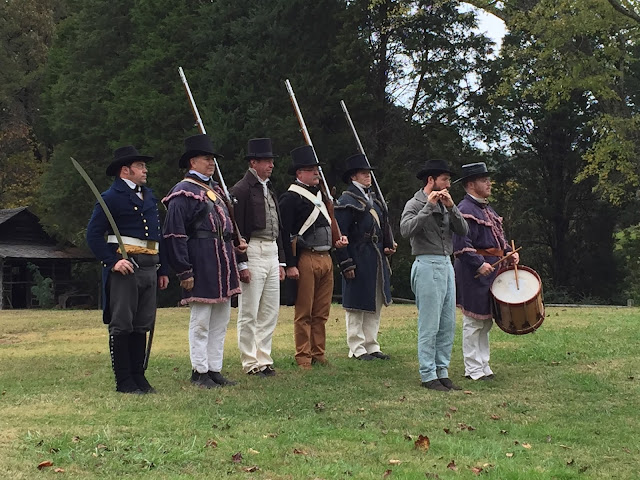
Living history on display during the War of 1812 Muster at Marble Springs. Author photo.


   With the war engaged, Sevier’s thoughts turned again toward his son, George. After learning that George had come down with a case of rheumatism, Sevier pleaded with his son to return home. “I wish you could spend a summer at Marble Springs,” he wrote, “probably the Water would relieve you, as it has done me — I am very confident it was that water alone that gave me any relief.” Sevier also expressed a growing concern over George and his family’s safety, living on the far reaches of the American frontier. “The Indians are doing much damage on the frontiers everywhere,” he wrote. “I hope you will prepare for the worst. Your station is much exposed, you can’t be too cautious.”

   At the onset of the war, the theater of operations concentrated on the Canadian-American border. Tennesseans, eager to fight, offered their services to the government; but distance prevented the state’s citizens from making any direct contribution. However, when President James Madison called on Tennessee to help defend the "Lower Country," Tennesseans volunteered en masse, earning Tennessee the nickname "The Volunteer State." Sevier reported to his son, George: “The Militia are turning out everywhere with great alacrity, and also the recruiting service is going on very briskly.”

   Governor Blount was asked to send 1,500 troops for the defense of the lower Mississippi region and an expedition under the command of Andrew Jackson was outfitted in December 1812. The theater of war quickly spread south, toward Florida, and into Creek Territory, where General Jackson ultimately carried “Fire and Sword” to that country at the Battle of Horseshoe Bend.

   Meanwhile, back in Washington, D.C., Sevier and his fellow members of Congress struggled with what to do in the aftermath of a devastating attack on our nation’s capital. In August of 1814, the British burned Washington to the ground. The government was in disarray.

   In the months that followed, Sevier noted in his diary that the House of Representatives “negotiated a bill for the removal of the seat of Government” following the burning of Washington. And as the 13th Congress returned to Washington, they convened in makeshift quarters at the Patent Office and at other locations throughout the district to conduct their legislative business, while workers toiled to resurrect the capital from the ashes.

   On Christmas Eve, 1814, after months of negotiations, British and American diplomats signed the Treaty of Ghent, restoring relations between the two nations to the status quo, before the war started – in essence, ending the War of 1812 in a stalemate. News of the treaty signing didn’t reach American shores until early the following year, and the Senate didn’t approve the treaty until February of 1815. It was during this intervening period that Andrew Jackson marched his troops to New Orleans to claim victory at the Battle of New Orleans, thus giving Americans a victory in the war against Great Britain, all during a time of negotiated peace.

   Following General Jackson’s decisive victories in the Creek War and the Battle of New Orleans, Americans expressed overwhelming jubilation over the outcome. Sevier’s nephew, Ensign John Sevier of the Seventh U.S. Infantry, flaunted his exaltation in a January 10, 1815, letter to his mother. “I feel young and active and handsome…” He wrote. “I believe we in the South have settled the dispute of Nations.” In Congress, members congratulated the Tennessee delegation. It was “as though we had been in the action,” Sevier wrote. On this occasion, Sevier penned another letter to his son, George, this time expressing his pride in what had been accomplished. He wrote: “Our army from Tennessee is more talked of here than half the world besides.”

   As the nation celebrated, President Madison appointed Sevier as a commissioner to run the boundary line of the conquered Creek Nation. Sevier dutifully accepted this mission and departed this very plantation on June 10th, 1815 to begin what would become his final campaign.

Marble Springs State Historic Site. Author photo.


   As Sevier surveyed the landscape, his mind and body grew weary of the journey that had taken him from his beloved Marble Springs home. In his diary, Sevier noted, “Some unwell with pain in my back” and he later observed that one of his traveling companions, a man named Dicky Brown, became “very sick.”

   In the days that followed, Sevier himself contracted a fever. Still, he found the strength to attend a feast of the Indians known as the “Green Corn Dance,” and although approaching his seventh decade of life, Sevier eagerly participated in the ceremony, feeling briefly rejuvenated by the festivities.

   The next day, however, while on his return to Fort Decatur, Sevier’s health suddenly took a turn for the worse. Realizing he may be nearing death, Sevier had asked his men to carry him across the river to a spring located about a mile away and let him get a drink of water. He had hoped that the cool spring water would restore his health. Unfortunately, Sevier never made it to that spring alive.

   Legend asserts that Sevier died as his men carried him across that river on September 24th, 1815. Honoring his final wish, the Sevier’s companions transported his body to a hill overlooking the spring and buried him there with full military honors. A simple two-foot-long oak stump charred at its end marked his grave until a proper grave marker could be installed on that remote spot of land.

   Unaware of Sevier’s illness, Tennesseans had just reelected him to Congress without opposition. News of his death, however, quickly spread to the state capitol where members of the Tennessee General Assembly mourned their fallen hero. On October 26th, 1815, legislators passed a resolution requiring each member of the General Assembly wear a crepe on the left arm for thirty days “in honor to the memory of that distinguished fellow citizen, statesman, and patriot.”

   Years after his death, the Daily Picayune newspaper of New Orleans observed that those cool spring waters “still sing a constant requiem near his grave.” Seven decades passed before Sevier’s descendants and loyal admirers saw fit to deliver his body back home to native soil, on the grounds of the Old Knox County Courthouse, where his remains now rest beneath “a cenotaph worthy” of the memory of his achievements.

   As we remember Sevier’s role in the War of 1812, I’d like to conclude my remarks with a quote from my book, John Sevier: Tennessee’s First Hero. On June 19th, 1889, the Reverend Dr. James Park delivered a closing prayer during Sevier’s reinterment ceremonies here in Knoxville. On that occasion, the Reverend observed:

“Here, with patriotic pride in his heroic days in time of war, and profound veneration for his high service in time of peace, we commit his mortal remains to the grave, ‘earth to earth, ashes to ashes, and dust to dust.’ And may the people of this great State who owe so much to John Sevier for his unselfish service in times that tried men’s souls, do him justice, and yourselves and the commonwealth honor by erecting such a monument as shall keep his name and fame an illustrious example in everlasting memory.”


Gordon Belt is an information professional, archives advocate, public historian, and author of The History Press book, John Sevier: Tennessee's First Hero, which examines the life of Tennessee's first governor, John Sevier, through the lens of history and memory. On The Posterity Project, Gordon offers reflections on archives, public history, and memory from his home state of Tennessee.

"That distinguished fellow citizen, statesman, and patriot." The death of John Sevier...

   In recognition of the upcoming 200th anniversary of John Sevier's death, I offer the following edited excerpt from my book, John Sevier: Tennessee's First Hero...

   September 24, 2015 marks the 200th anniversary of John Sevier's death. Sevier passed away following a brief illness suffered during a journey to survey Creek territory. Following Andrew Jackson’s conquest of the Creeks and the resulting Treaty of Fort Jackson which effectively ended the Creek War, President James Madison appointed Sevier as a commissioner to run the boundary line of the new Creek Nation. The terms of the treaty ceded more than 20 million acres of Creek territory in southern Georgia and central Alabama to their conquerors. Despite his lingering bitterness toward Jackson over their previous encounters, Sevier accepted the appointment and departed his plantation home near Knoxville on June 10, 1815 to begin what would be his final mission.

Creek Chief William “Red Eagle” Weatherford surrenders to Andrew Jackson on August 9, 1814, ending the Creek War.
Tennessee Historical Society Collection, Tennessee State Library and Archives.


   Sevier made several entries in his diary following his departure. Although these consisted mostly of mundane observations about the weather and provisions, by August, the summer heat and the arduous journey began to take its toll on his aged body. On August 26, 1815, Sevier noted, “Some unwell with pain in my back.” By September 9, he observed that one of his traveling companions, a man named Dicky Brown, became “very sick.” In the days that followed, Sevier himself contracted a fever. A few days later, he breathed his last breath. On September 24, 1815, Sevier died in his tent on the Creek boundary, ironically as duty called him to survey territory conquered by his most bitter rival.

   On March 29, 1889, years after his death, The Daily Picayune newspaper of New Orleans printed the legend that emerged from that dark day:

There is a pretty story still told around the firesides in this country of how Governor Sevier came to his death. He was attending a feast of the Indians known as the ‘Green Corn Dance,’ and although nearly 72 years of age, was there participating in the festivities of the evening. The next day, while on his return to Fort Decatur, he was taken suddenly sick, and while being carried across the Tallapoosa river, and feeling that he was dying, he said to his attendants that if they would carry him to a big spring about a mile away and let him get a drink of the water he thought he would get well. But he died while crossing the river, and his body was buried on top of the hill overlooking the big spring to which he had referred, and whose waters still sing a constant requiem near his grave.

   Sevier’s companions buried him with military honors on a spot of land not far from where he fell ill, on the east bank of the Tallapoosa River near Fort Decatur, Alabama. A simple two-foot-long oak stump charred at its end marked his grave. Unaware of Sevier’s illness, Tennesseans had re-elected him to Congress without opposition a few weeks prior. News of his death, however, quickly spread to the state Capitol where members of the Tennessee General Assembly mourned their fallen hero. On October 26, 1815, State Senator Adam R. Huntsman offered a resolution that each member of the legislature wear a crepe on the left arm for thirty days “in honor to the memory of that distinguished fellow citizen, statesman, and patriot.”

June 17, 1889, a plum tree shadows the grave site of John Sevier near Decatur, Alabama.
Tennessee Historical Society Collection, Tennessee State Library and Archives.


   Following this month-long period of mourning, Sevier’s remains lay buried beneath that charred oak stump for several decades before any effort commenced to resurrect his memory from the Alabama soil. Years of weathering and decay removed most outward signs of Sevier’s final resting place. By the summer of 1834, a man who helped bury Sevier’s body, Captain William Walker, returned with his nephew, John Harbinson, to locate the grave. In a letter penned on December 5, 1874, a native Tennessean living in Alabama named Littleberry Strange recalled Capt. Walker’s visit:

We went to the place where [Harbinson] stated Gov. Sevier was buried ; we commenced and continued digging until we struck a hard substance in the surface.

We dug up the substance, and found it to be the charred end of a post oak log or stump, some two or two and a half feet long. Mr. Harbinson identified that as the place where lay the remains of Gov. Sevier.

Capt. Walker took a light wood knot, some two feet long, placed it in the hole from which we had taken the charred end of the post oak log and said that there he intended to place a marble slab.

In 1836 Capt. Walker went with Gen’l Jessup to Florida, to the Seminole War, where he died without carrying out his noble purpose of placing the marble slab at the head of the grave of John Sevier.

Capt. Walker was a noble man; he was a patriot; he loved his country; he loved the noble dead, and for these qualities I esteem him.

And that his noble purpose might be carried out — he and Harbinson both being dead — I — for the purpose of carrying out his intention, and for the further purpose of assuring posterity of the location of the last resting place of a noble man — I, in 1841, procured marble slab and stone and placed them at the head and foot of the grave of Gov. John Sevier, and I have no doubt that these stones mark the true spot.

   The small white marble headstone that Littleberry Strange placed on that site measured two feet wide by two inches thick and bore the simple inscription:


“J. Sevier. died Sept. 24th 1815.”


John Sevier's original tombstone, now located on the facade of the Old Knox County Courthouse in Knoxville, Tennessee.
Author photo.


   Posterity neither erected a statue in his honor nor embellished his epitaph with details. Years later, Sevier’s grandson, George Washington Sevier, grieved, “That arm that so often drew the sword in defense of his country has long mouldered in the soil of a sister State and Tennessee does not now know where the mortal remains of Gen. John Sevier lies.” While no monument yet stood in Sevier’s memory, in his Annals of Tennessee, J. G. M. Ramsey delivered a poetic tribute which offered mourners some solace:

How died that hero In the field, with banners o’er him thrown
With trumpets in his falling ear by charging squadrons blown
With scattered foemen flying fast and fearfully before him
With shouts of triumph swelling round, and brave men bending o’er him
He died not thus ; no war note round him rang ;

No warriors underneath his eyes in harness’d squadrons sprang ;
Alone he perished in the land he sav’d,
And where in war the victor stood, in peace he found a grave.
Ah, let the tear flow freely now, it will not awake the sleeper.
And higher as ye pile his tomb, his slumber shall be deeper.

Freemen may sound the solemn dirge — the funeral chant be spoken ;
The quiet of the dead is not by idle mockeries broken !
Yet, let Tennessee’s banner droop above the fallen chief.
And let the mountaineer’s dark eye be dim with earnest grief ;
For who will stand as he has stood, with willing heart and hand,
To wrestle well with freedom’s foes,— defender of his land !


   As time passed and memories grew distant, John Sevier’s body remained buried in the Alabama soil. Over time, his humble grave deteriorated as the legend of “Nolichucky Jack” faded. His frontier exploits vanished from the public consciousness. An editorial published in the Nashville True Whig lamented, "History has been strangely neglectful of the memory of this, one of the most distinguished pioneers of our State." Not until the end of Reconstruction following the Civil War did Sevier’s remains and memory finally receive honor in a manner fitting of “Tennessee’s First Hero.”


Gordon Belt is an information professional, archives advocate, public historian, and author of The History Press book, John Sevier: Tennessee's First Hero, which examines the life of Tennessee's first governor, John Sevier, through the lens of history and memory. On The Posterity Project, Gordon offers reflections on archives, public history, and memory from his home state of Tennessee.

"Your most obedient humble servant." Salutations from America's first frontier

   John Sevier often ended his letters with the following valediction:

"Your most obedient humble servant."


   During the late-eighteenth and early-nineteenth centuries, men of Sevier's social and political stature used some version of this phrase so frequently that I thought it appropriate to use it myself during book signing events for John Sevier: Tennessee's First Hero. The gesture evokes feelings of loyalty and humility, and projects a statesmanlike quality that I find admirable.


   The expression of good manners found in this polite farewell greeting was once considered a hallmark of a gentleman. With modern society's current obsession with social media soundbites and hashtags, however, I feel that we have lost the simple civility expressed in these kind words. When was the last time you received a hand-written letter, much less a "Sincerely Yours" that was, in fact, sincere?

   In my ongoing effort to root myself more deeply in the time-honored traditions of the past, I wanted to learn more about the letter writing practices of this earlier time. So, I've compiled a brief list of books I'm planning to read on this subject. I share them with you today as "Your most obedient humble servant."


Sincerely Yours,


Gordon Belt is an information professional, archives advocate, public historian, and author of The History Press book, John Sevier: Tennessee's First Hero, which examines the life of Tennessee's first governor, John Sevier, through the lens of history and memory. On The Posterity Project, Gordon offers reflections on archives, public history, and memory from his home state of Tennessee.

Recollections of Watauga...

   The month of July marks an important anniversary in the history of my home state of Tennessee. In July of 1776, settlers of the Holston, Watauga, and Nolichucky river valleys came under attack by Native American warriors led by the Cherokee Chief Old Abraham (or "Abram") of Chilhowee. Repulsed in the initial attack, the Cherokees besieged Fort Caswell on the Watauga (known also as Fort Watauga) for two weeks. John Sevier's defense of the fort, and the legends that followed, helped forge his reputation as a military leader and political force in the region. Following up on my earlier blog entry about William Tatham as an eyewitness to the Siege of Fort Watauga, I'd like to share a few more recollections of this important event in early Tennessee history...

   Few contemporary accounts of the Siege of Fort Watauga survive. They do exist, however, for those who wish to find them. They remain buried deep within the manuscripts collected by the nineteenth-century antiquarian Lyman Draper, documented in Revolutionary War pension applications, and printed in the pages of early newspaper accounts. Tennessee's collective memory of the siege, however, rests firmly in the nostalgic prose of Dr. J. G. M. Ramsey's 1853 book, Annals of Tennessee. In his seminal work chronicling Tennessee's early history, Ramsey wistfully recalled his research visit to view the remnants of Fort Watauga. He wrote...

   "The spot is easily identified by a few graves and the large locust tree standing conspicuously on the right of the road leading to Elizabethton. Let it ever be a sacrilege to cut down that old locust tree – growing, as it does, near the ruins of the Watauga fort which sheltered the pioneer and protected his family."

   Ramsey considered his research visits to Elizabethton a pilgrimage. Watauga had captured Ramsey's imagination "with intense curiosity and almost with veneration." In his Annals of Tennessee, Ramsey declared Watauga "the abode and resting place of enterprise, virtue, hardihood, patriotism—the ancestral monument of real worth and genuine greatness." [Ramsey, 140-141]

Watauga Fort Marker
Image credit: The Historical Marker Database


   Few recollections from the actual defenders of Fort Watauga eclipsed Ramsey's romantic narrative, yet two reports that surfaced less than one month after the attack echoed his patriotic sentiment.

   An "Account of the Attack of Watauga Fort by the Cherokees," published in August of 1776, and widely circulated among newspapers of the period, revealed the following:

Williamsburgh, Virginia, August 10, 1776.

   A correspondent has favoured us with extracts of letters from officers of rank in Fincastle, from which we learn, that on Sunday, the 21st of July, a large party of Indians attacked the Watauga Fort, in which were one hundred and fifty men. They fired on a great number of women, who went out at daybreak to milk their cows, and chased them into the fort, but providentially did not kill one of them.

   They fired briskly on the fort till eight o' clock, but without effect, and then retired, with considerable loss, as was supposed from the quantity of blood found; but they returned to the attack, and were besieging the fort six days after, as a messenger, who was slipped out, informed our men on Holstein. A detachment was sent to relieve the fort, and it was expected they would do so on Monday, the 29th. A party of one hundred men of the Militia fell in with a party of forty Cherokees, who were fifty miles on this side the Island, at one of the deserted plantations, and killed five, took one prisoner, and twenty guns.

   It is worthy of our observation, that in these several skirmishes with the Indians, in all of which we did more execution than in some of the principal actions of the last war, we lost not a man. No one can reflect on this, and many other circumstances which have attended the present war with the British tyrant, without acknowledging that he sees evident proofs of the Divine interposition in our favour. [LINK]


The Fort Watauga reconstruction at Sycamore Shoals State Historic Park. The original fort was built in the mid-1770s to protect the Watauga settlers from Cherokee attacks. The fort was reconstructed in the 1970s based on archaeological evidence and the design of contemporary Appalachian frontier forts.
Image and caption credit: Wikimedia Commons.


   Further, "Intelligence from Williamsburgh, Virginia," published on August 16, 1776, detailed the depredations endured by the settlers prior to the Siege of Fort Watauga, and placed the Indian Wars in regional context, less than one month after the siege...


Williamsburgh, August 16, 1776.

   On Tuesday, the 13th instant, the First Virginia Regiment in the Continental service marched from this city for New York. From undoubted authority we can assure the publick that fifteen thousand weight of pure lead have been got from our mines in the back country, which, after being cast into bullets, we hope will be unerringly directed against our enemies.

   The last advices from the back country are, that the Cherokee and Creek Indians, to the number of between six and seven hundred, are encamped in Carter's valley, from whence they send out parties against the settlements, some of which had penetrated near one hundred miles on this side of the Big Island, carrying destruction wherever they come, by burning houses, fences, fields of wheat and other grain, and turning droves of horses into the corn-fields. Upwards of one thousand head of horses have been driven off, and a great number of cattle; the sheep and hogs they shoot down. They have killed and scalped eighteen men, one or two women, and several children; some of the people were most barbarously murdered, too shocking to relate.

   The ruined settlers had collected themselves together at different places, and forted themselves, four hundred and upwards at Major Shelby' s, about the same number at Captain Campbell's, and a considerable number at Amos Eaton' s. The fort at Watauga, which was besieged by four hundred savages, are now relieved, the Indians having abandoned their enterprise upon the approach of Colonel Russell, with about three hundred men. In all the skirmishes with the Indians our people have continually worsted them, and, in the whole, have killed and scalped twenty-seven, and badly wounded many others, as was discovered by the tracks of blood. A man from the frontiers of Georgia had arrived in Fincastle, who declared upon oath, that he saw upwards of one hundred people buried in one day, who were killed by the Creek Indians.

   By an express from Colonel Russell, of Fincastle, we learn, that on his approaching the Watauga Fort with the men under his command, the Indians retired precipitately; however, not without losing one man, and having two wounded, by a party that pursued them. The fort was thus fortunately relieved after a fortnight's close siege, during the greater part of which time our people lived on parched corn. There were supposed to be five hundred women and children in this little fort, who fled there for shelter on hearing that the Indians were marching into that part of the country. We lost not a man in this long affair, except four or five who ventured out to drive in some cows; these were found scalped.

   The number of Indians concerned in the different ravages lately committed in Fincastle amount to six or seven hundred, some say eight hundred; and yet, sudden as their attack was, they murdered in all their butchering parties but eighteen persons, and wounded six, whilst our men killed in the skirmishes with them twenty-six on the spot, (as many were carried off dead,) took one prisoner, and wounded at least as many as they killed. As the Cherokees have been so completely checked in their career, and we understand from Fort Pitt that the Northern Indians are not disposed to attack us in that quarter, and have only engaged not to suffer us to march through their country against Detroit, we may hope that there is not much to be dreaded from the terrible combination of Indians we have been threatened with by our enemies. [LINK]

   It is curious to note that not one of these reports specifically mention John Sevier's heroic defense of Fort Watauga, or Bonny Kate's dramatic rescue from her Cherokee pursuers in the moments preceding the siege. Yet, those stories endure in oral narratives and secondary accounts published years after the fact as key episodes in the drama of the Siege of Fort Watauga. In this season of independence, I offer these contemporary accounts as an act of remembrance of the Siege of Fort Watauga.


SELECTED SOURCES:

  • American Archives, ed., Peter Force. Available online, courtesy of Northern Illinois University Library, http://amarch.lib.niu.edu/.


Gordon Belt is an information professional, archives advocate, public historian, and author of The History Press book, John Sevier: Tennessee's First Hero, which examines the life of Tennessee's first governor, John Sevier, through the lens of history and memory. On The Posterity Project, Gordon offers reflections on archives, public history, and memory from his home state of Tennessee.

Polygamy on the Early Tennessee Frontier

Last week, I had the opportunity to listen to Cumberland University professor Dr. Natalie Inman as she delivered a thought-provoking lecture to members of the Tennessee Historical Society at the Fort Negley Visitor's Center. Her presentation, "Polygamy in the Early Republic: The Case of Indian Agent Joseph Martin," not only covered Martin's wildly fascinating married life -- he had 23 children with four different wives, white and Cherokee -- but also examined the polygamist culture that existed on the Tennessee frontier.

According to Dr. Inman, intermarriage between white settlers and Native Americans became a necessary survival tactic on America's new frontier. Inman argued that white men needed Cherokee wives to conduct business on the frontier as a means of cross-cultural cooperation. Cherokee culture embraced a maternally-focused family structure, unlike Euro-American cultures which were inherently paternalistic. Within the Cherokee family structure women held far more power than men. Recognizing this, white men often married Cherokee wives not for love, but rather in order to acquire land or negotiate trade routes. Inman argued that Indian Agents, like Martin, used marriage as a negotiating tactic in diplomatic relations, and though frowned upon in America's Euro-centric culture, both intermarriage and adultery were accepted norms on America's early frontier.

The acquisition of land was a frequent ambition of white settlers of "THE CHEROKEE COUNTRY," and white men often relinquished control to women in the maternalistic Cherokee culture in order to obtain land rights and diplomatic leverage in trade negotiations. 
Image credit: The Project Gutenberg eBook of Myths of the Cherokee, by James Mooney, 1900.


Inman also discussed the rivalry that existed between Martin and John Sevier, a topic I briefly explored on The Posterity Project a few months ago. Martin's position as an agent and superintendent of Cherokee Indian affairs put him squarely at odds with Sevier, who saw the Cherokees as a threat to establishing sovereignty for his fragile State of Franklin movement. During her talk, Inman described Martin as a "warrior" who protected his Cherokee family against Sevier's unnecessary aggression, while he simultaneously sought protection for his white family during the State of Franklin conflict. According to Inman, hard times created more complex household structures, and on the American frontier, complex families, like Martin's, were more common than one might expect.


Questions about John Sevier's own married past...


As a public historian, I make my living, in part, by seeking the truth about our collective past. In my ongoing blog series about John Sevier, and in my book, John Sevier: Tennessee's First Hero, I have frequently challenged long-held traditions and beliefs in search for the truth. Sometimes, this quest for truth leads me down elusive paths.

One of the unanswered questions that I occasionally receive from readers concerns Sevier's descendants -- more specifically his relationship with the indigenous Cherokee population of Tennessee, and rumors of an alleged affair Sevier had with an unknown Cherokee woman. Whispers of this rumor can be found on various online publications and genealogy forums, but finding credible primary and secondary published sources to back up those online claims has proved challenging.

One article published online and shared widely among family history researchers asserted, "several families claim a lineage to John Sevier and an unknown Cherokee Indian woman. Their daughter, Winney Alice Sevier, was left by her mother in Russell County, Virginia, at the Henry Campbell farm. Winney later fell in love with Campbell’s son, Abraham, whom she married and lived with in a home on the adjacent farm." The article, no longer available online, borrowed liberally from previously published narratives of Sevier's life without attribution, and so I hesitate to give much weight to this assertion.

A more credible source shared by a reader of this blog recalled the story of "Ann Eliza Carter." Anna Eliza was born Nov. 17, 1825, the daughter of William Carter and Lucindia Sevier. In her book, Notable Southern Families, Volume IV: The Sevier Family, buried in a reference to Lucindia Sevier's lineage, Zella Armstrong wrote that as a young girl Ann Eliza recalled that "she knew very little of her ancestry, but was told she was a grand-daughter of Governor John Sevier." Armstrong chronicled young Ann Eliza's memories of her family history stating, "She remembers that in her childhood, an old lady lived at her home who was called Aunt Winnie Sevier. She does not know whether this was her deceased mother's sister or aunt." No mention of Cherokee ancestry here, but with only vague recollections about Winnie(ey) Sevier's lineage the speculation persists.

Another name recently surfaced in my email correspondence with Sevier descendants. Obedience Hillard Sevier is a name cited on genealogy message boards as someone with a familial connection to Sevier. Some allege that Sevier fathered Obedience with a Cherokee mistress, while others state that Obedience was an indentured servant to the Sevier family who took on her master's name. Still others claim there was likely no relation to Sevier whatsoever, and the connection is based purely on myth and misinformation. The latter claim seems more plausible to me, but after hearing Dr. Inman's lecture, I do wonder... Did Sevier engage in his own "diplomatic" relations with the Cherokees in the same ways as his enemy, Joseph Martin? It's not an unreasonable question given the long history of this practice on the early frontier, but a lack of definitive historical evidence in this case makes proving the connection difficult, if not impossible. It's a question we may never fully answer.


A thought-provoking question...


I want to clearly state that I am not a professional genealogist, and my book is not a genealogy of the Sevier family. John Sevier: Tennessee's First Hero examines Sevier's life within the context of history and memory. It is not a Sevier family history. Still, I have extensively researched Sevier's life, with particular attention to his military campaigns against the Cherokees.

I have yet to encounter a credible source that definitively proves a familial link to Sevier and the mysterious Cherokee children sharing his surname, and I certainly cannot project the actions of those like Martin onto Sevier. Yet questions about Sevier's alleged affair with a Cherokee mistress remain unanswered. This is a topic that I'm sure some will find provoking, but one that I hope will challenge us all to examine the past, "warts and all."


Gordon Belt is an information professional, archives advocate, public historian, and author of The History Press book, John Sevier: Tennessee's First Hero, which examines the life of Tennessee's first governor, John Sevier, through the lens of history and memory. On The Posterity Project, Gordon offers reflections on archives, public history, and memory from his home state of Tennessee.

William Tatham, Wataugan

   As Sycamore Shoals State Historic Park prepares to celebrate its annual observance of the Siege of Fort Watauga (or more accurately, Fort Caswell), I thought the occasion offered an appropriate moment to reflect upon the recollections of one of the fort's original defenders, William Tatham.

   William Tatham (1752-1819), the eldest of five children born in England, emigrated to Virginia in 1769. Upon his arrival, he found employment as a clerk with the mercantile firm of Carter & Trent, merchants operating on the James River. Tatham spent many hours during his years of service with Carter & Trent listening to the wild and fascinating tales of the longhunters who frequented the Virginia wilderness. He sought the same sense of adventure for his own life, and by 1774, the lure of the frontier brought Tatham to Watauga. There he later witnessed the Cherokee siege of Fort Caswell in the summer of 1776.

   The Cherokees besieged the fort for two solid weeks leaving its inhabitants short on food and supplies. John Sevier, James Robertson, and their fellow defenders held off the Cherokee assault and awaited reinforcements, but by the time that they arrived, the Cherokees had already abandoned their attack.

   The siege at Fort Caswell on the Watauga is an episode of Tennessee history wrapped in myth and memory. In the years that followed, oral traditions, repeated by succeeding generations and validated by the published accounts of late-nineteenth century antiquarians and storytellers, embellished the details of this engagement with each telling. These authors recalled the tale of John Sevier's rescue of Catherine "Bonny Kate" Sherrill at Fort Caswell, in particular, with literary flair.

   In his Annals of Tennessee, Dr. J. G. M. Ramsey chronicled Sevier's "determined bravery" in helping to defend the fort, and in his book, Rear-Guard of the Revolution, James Gilmore described how Sevier courageously faced down "two or three hundred savages" as a young "Bonny Kate" ran from her Cherokee pursuers and into the arms of her rescuer.

"Siege of Fort Watauga." An artist's sketch of Catherine "Bonny Kate" Sherrill's escape from Cherokee pursuers.
Image credit: Tennessee State Library and Archives


   Decades later, as the jurist and antiquarian Samuel Cole Williams began compiling research notes for a book about the Lost State of Franklin, he learned that Tatham had been a witness to the Siege of Fort Caswell. Inspired by this story, Williams published a thin biography in 1922 entitled, William Tatham, Wataugan. He later published a revised, though still brief, edition of his Tatham biography in 1947.

   According to Williams, Tatham was "the only defender of Fort Caswell who wrote reminiscences of occurrences during that early invasion." Despite his close proximity to the event itself, Tatham's account of the Siege at Fort Caswell revealed his own embellishments, and Tatham likely overstated his role in defending the fort. Nevertheless, Williams "made liberal use of Tatham's writings" in his own works, including History of the Lost State of Franklin, Dawn of Tennessee Valley and Tennessee History, and Tennessee During the Revolutionary War, among numerous other titles.

   Tatham's full account of the Siege of Fort Caswell originally appeared in the April 6, 1793 edition of the Knoxville Gazette. Williams later published Tatham's account in his book, William Tatham, Wataugan. This is William Tatham's story:

   In January 1776 emigration had advanced over the Indian boundary as far as Big Creek on the north side of Holston and to Big Limestone Creek on the south side, but these settlers were under no legal or regular government.

   Added to this there were a number of people called Regulators, who had fled from North Carolina to the extreme frontier for safety after their battle against Governor Tryon at the Alamance and were actually about joining the Cherokees against the Americans. To make the matter still worse, while the Indians were on their invasion, the chief stock of powder was but six pounds in the hands of the settlers [on the Watauga].

   In this dilemma, the Virginia government gave orders for all men to retire within the line or they would be treated as outlaws. The people on the north side of the Holston obeyed the mandate; but through the influence, in a great degree, of William Cocke, Esq., they forted themselves at Amos Heaton’s [Eaton’s] now [1793] Sullivan Old Court House; and those on the Watauga and Nolichucky posted [at the latter] about thirty volunteers under Captain James Robertson, just above the mouth of Big Limestone, where Mr. Gillespie now lives.

   Shortly after this party took post and before they had finished their fort, called Fort Lee, four of the traders made their escape from the Cherokee nation and apprised them of the immediate march of about six hundred Cherokees and a few Creeks, who were destined against the settlements. The inhabitants immediately took the alarm, and instead of flocking to the frontier barrier on strong and open ground, thereby covering their country, those on the Nolachucky hastily fled, carrying off their livestock and provisions leaving about fifteen of the volunteers at the frontier to make the best shift in their power.

   The result of this precipitate retreat was this: The few who were determined to oppose the enemy in the defense of that quarter were joined by as many in the rear of the scamper as had not time to get safely off: and were thus compelled to fortify near the Sycamore Shoals of Watauga, on much weaker ground than that which they had evacuated: cut off from assistance and resources [from North Carolina] by the mountains and defiles which were at that day almost impenetrable; and from every possibility of information, save for their own vigilance.

   The party at Heaton’s fort were nearly in a similar situation; and these two posts, weak as new settlements could be, had to stand the brunt of the enemy whose numbers, prowess, resources and European patronage was at least equal to any danger that we now dread at this day. On the southern and western side of Donelson’s line we were obliged to rely upon the following numbers for defense against both southern and northern Indians, as near as I can recollect.

   At Watauga, men, boys and negroes fit to bear arms, but not well armed, under Captain James Robertson. Yet the country was well defended! And strange as it may appear this territory [Southwest] owes its present consequence to this handful of men; for in less than two years after, the Tennessee and Kentucky countries contained no less than fifty-seven forts. It is very probable that if this small party had given way, the people would have generally (if not all) fled to the eastern side of the Allegheny mountains.


A recreation of Fort Caswell (a.k.a. Fort Watauga). Image credit: Sycamore Shoals State Historic Park.


William Tatham, Wataugan by Samuel Cole Williams is available in most public or university libraries, and may be purchased through any number of used book stores or antiquarian book dealers.


Gordon Belt is an information professional, archives advocate, public historian, and author of The History Press book, John Sevier: Tennessee's First Hero, which examines the life of Tennessee's first governor, John Sevier, through the lens of history and memory. On The Posterity Project, Gordon offers reflections on archives, public history, and memory from his home state of Tennessee.

The Battle of Point Pleasant and Virgil Lewis' fight against "Manufactured History"

Book Review: History of the Battle of Point Pleasant by Virgil A. Lewis. Charleston, WV: The Tribune Printing Company, 1909.


   In the "Prefatory Note" to his 1909 work, History of the Battle of Point Pleasant, Virgil Anson Lewis described growing up "within a few miles of the battlefield of Point Pleasant, the chief event of Lord Dunmore's War, and reared largely among the descendants of the men who participated in that struggle." Lewis' great-grandfather, Benjamin Lewis, fought in the Battle of Point Pleasant and received wounds during his active participation in that pivotal engagement. One might imagine the vivid conversations Lewis had with those proud men -- only a generation or two removed from our nation's "Founding Fathers" -- who passed down the stories of their accomplishments on the field of battle to their own sons and daughters.

   It stands to reason, therefore, that Virgil Lewis took enormous pride in his ancestor's role in the Battle of Point Pleasant. As a historian, however, he carefully avoided platitudes. In his book, Lewis took great pains to note that the battle, while important, did not signal the beginning of the Revolutionary War, and he scoffed at earlier writers' efforts to canonize the victors as the first Patriots of the American Revolution.

   "Much error has been incorporated into the later writings regarding Dunmore’s War," Lewis wrote. "This is the result of a carelessness on the part of those, who without making research and investigation necessary to arrive at truth, seized rumors, traditions, and vague recollections, as sufficient authority upon which to base an assertion, and who substituted their own inferences for authenticated facts. These errors of statement have sometimes been repeated by considerate writers whose distrust was not excited; and this has increased the difficulties of pains-taking historians." Calling such errors "the gossip of history," Lewis hoped that his book would dispel the "myths, legends and traditions" associated with the Battle of Point Pleasant. Folklore and fairytale, however, persisted.


LORD DUNMORE'S WAR

   Waged beneath the shadows of the British flag, and under the command of Virginia's Royal Governor, John Murray, the Earl of Dunmore, the Battle of Point Pleasant -- known as the Battle of Kanawha in some older accounts -- was the only major action of Lord Dunmore's War. In 1774, Lord Dunmore called upon Virginia's House of Burgesses to finance and support an army raised to quell violence on the frontier. Colonial settlers in territory south of the Ohio River sought to defend themselves against attack from Native Americans, who themselves sought to protect their hunting grounds from the white settlers "pressing down from the Alleghenies." Both sides claimed that the other had violated negotiated treaties protecting their right to occupy and hunt on the land. Bloodshed ensued.

JOHN MURRAY, FOURTH EARL OF DUNMORE (ca. 1730–1809)
Image credit: Library of Virginia


   Following a series of gruesome attacks upon the settlers by Indians, the Virginia legislature issued a plea to Lord Dunmore to respond:

   "It gives me great pain, my Lord, to find that the Indians have made fresh encroachments and disturbances on our Frontiers; we have only to request that your Excellency will be pleased to exert those powers with which you are fully vested by the Act of Assembly, for making provision against Invasions and Insurrections, which we have no doubt, will be found sufficient to repel the hostile and perfidious attempts of those savage and barbarous Enemies."


   With the support of the Virginia House of Burgesses, Lord Dunmore created two armies, personally leading seventeen hundred men from the north, while Colonel Andrew Lewis directed another eight hundred troops through the Kanawha Valley. A confederation of Indian tribes, led by the Shawnee Chief Cornstalk, gathered to meet Colonel Lewis and his men at the point of attack. On October 10, 1774, the Battle of Point Pleasant commenced.

   After a long and brutal fight lasting for several hours and ultimately won in bloody hand-to-hand combat, Cornstalk's warriors were forced into retreat. The Virginians had held their ground, and in the process captured 40 guns, many tomahawks and supplies, and killed an indeterminate number of Indians. Lord Dunmore later forced Cornstalk to sign a peace treaty ceding to Virginia the Shawnee claims to all lands south of the Ohio River, thus opening the land to further settlement.


JOHN SEVIER'S PARTICIPATION IN THE BATTLE

   Although no "official" roster of soldiers participating in the battle has ever been compiled, Lewis endeavored to list all those who fought at Point Pleasant in his book, relying upon information reported in Revolutionary War pension applications, as well as the personal stories and anecdotes told by descendants of the soldiers who fought in the battle.

   Many of the battle's participants were blood relatives. According to Lewis, John Sevier fought at the Battle of Point Pleasant alongside his younger brother, Valentine, who was among the first to actively engage the enemy on the morning of the battle. Evan Shelby and his sons, Isaac and James, also drew arms together in this conflict, and Lieutenant Isaac Shelby's flanking maneuver ultimately turned the tide of the battle. This stealthy military tactic did not go unnoticed by the young John Sevier, who frequently used a similar movement against the Cherokees in subsequent engagements.


THE LEGACY OF THE BATTLE

   In the years following the battle, veterans of the Battle of Point Pleasant and their descendants sought to commemorate their service, and drew tenuous connections to the American Revolution in their efforts. In 1899, Point Pleasant newspaper editor and publisher Livia Nye Simpson Poffenbarger organized an ambitious crusade in the State Gazette newspaper to have Point Pleasant officially designated the "first battle of the American Revolution," despite most historical interpretations which pointed to the skirmishes at Lexington and Concord, Massachusetts, on April 19, 1775. She boldly asserted that Lord Dunmore colluded with the Shawnee tribe, and never intended to join his northern forces with those of Colonel Lewis to the south. He had, according to Poffenbarger, anticipated the coming Revolutionary War and at Point Pleasant actually sought to weaken the citizen militia in advance of that conflict.

   Lewis saw it as his mission to correct this historical narrative. In the preface of his book, Lewis challenged these efforts of commemoration, describing their reliance on the "vague recollections" of the descendants of the battle as "careless" and without authority. He supported his own scholarship by gathering his research from "original sources, documents and writings which were contemporaneous with the occurrence of the events described." Indeed, Lewis's work is filled with extracts from journals, memoirs, affidavits, letters, speeches, and documentary histories, giving his book a gravitas other more embellished histories sorely lacked.

Portrait of Virgil A. Lewis, author of History of the Battle of Point Pleasant and West Virginia's first State Archivist
Image credit: The West Virginia Encyclopedia


Lewis later wrote a speech scolding this form of "manufactured history." He asserted:

   "Every student of American history who has made research for truth in the sources of information, at this time readily available, is aware of the falsity of this statement, that Point Pleasant is the scene of the first battle of the Revolution. He regrets the perversion of historic truth in connection with it. When that battle was fought there was no revolution in progress; there were no United Colonies, or United States. Dunmore's War was waged between Virginians and Indians, no other Colony participating. The Indians were not allies of England then, nor did they become such until the Spring of 1778-four years after the battle-and no student of either Virginian or American Annals now questions the integrity of Lord Dunmore, or his faithfulness to the interest of the Colony of which he was the Executive head. There was not an English soldier with the Indians at Point Pleasant; nor did England, or a representative of the British Government, furnish a gun, an ounce of powder, nor a pound of lead, to them. The Virginians in that battle, were at that time, loyal to their Colonial Government, and had every confidence in their Governor. Colonel Charles Lewis was killed while wearing the uniform of an English Colonel; and other officers who fell on that field were wearing that of their rank."


CONCLUSION

   There are certainly more recent works of scholarship about Lord Dunmore's War that one would do well to consult. Early indications are that Glenn Williams' recent release, Dunmore's War: The Last Conflict of America's Colonial Era, promises to be a compelling read. Still, Virgil Lewis's 1909 book, History of the Battle of Point Pleasant, has stood the test of time. Although written from the perspective of an early twentieth century historian and writer, Lewis' work provides valuable historical context, copious documentary notations, and details about specific soldiers who fought in the battle that genealogists will find useful in their own research.

   As for John Sevier's role in the Battle of Point Pleasant, one might conclude that a portion of Sevier's gallant reputation as a Patriot hero rests upon the myth that he fought in both the "first" and "last" battles of the Revolutionary War -- Point Pleasant and Lookout Mountain -- despite clear historical evidence contradicting claims that these battles were ever a part of that conflict. While he may have fought in these engagements, his participation certainly did not bookend the American Revolution.

   After reading Virgil Lewis' book, I must say that I feel a certain empathy for his fight for historical accuracy. Correcting long-standing historical narratives and pointing out myths and false legends can be an exhausting, solitary exercise, particularly when entire family legacies rest upon folktales that contradict fact and reason. Future generations and present-day historians owe a debt of gratitude to Virgil Lewis for taking a stand against "manufactured history."


History of the Battle of Point Pleasant by Virgil A. Lewis, The Tribune Company, West Virginia, 1909, is available in most public or university libraries, and may be purchased through any number of used book stores or antiquarian book dealers.


SELECTED SOURCES:

  • Virgil A. Lewis. History of the Battle of Point Pleasant Fought Between White Men and Indians at the Mouth of the Great Kanawha River. Charleston, WV: The Tribune Printing Company, 1909.
  • Charles H. Faulkner, Massacre at Cavett's Station. Knoxville: University of Tennessee Press (2013), pp. 15-16.


Gordon Belt is an information professional, archives advocate, public historian, and author of The History Press book, John Sevier: Tennessee's First Hero, which examines the life of Tennessee's first governor, John Sevier, through the lens of history and memory. On The Posterity Project, Gordon offers reflections on archives, public history, and memory from his home state of Tennessee.