Showing posts with label biography. Show all posts

Dueling personalities: Nolichucky Jack versus Old Hickory

Echoing E. E. Miller's observation about Tennessee's frontier roots, Carl S. Driver noted in his biography, John Sevier: Pioneer of the Old Southwest, that Tennessee has had "no real state hero since the pioneer days. The list began with John Sevier and ended with Andrew Jackson."

Miniature portrait of John Sevier by James Willson Peale.
Image courtesy of the Tennessee Portrait Project
National Colonial Dames of America in Tennessee

Indeed, the Volunteer State has had no larger political figures in its history than "Nolichucky Jack" (Sevier) and "Old Hickory" (Jackson). The interaction between these two men has been the subject of considerable inquiry by historians. What I find particularly fascinating is how John Sevier was portrayed in the press of the day, and much later by his biographers, following their famous (or infamous, depending on your perspective) duel on October 16, 1803.

The personal rivalry between John Sevier and Andrew Jackson began in 1796 when Jackson offered himself as a candidate for major general of the state militia. Governor Sevier, however, favored another person, George Conway, and helped to secure Conway's election to that post. Jackson became infuriated, but Sevier brushed the young upstart politician aside, claiming that he cared little about the charges of a "poor pitiful petty fogging Lawyer."

The feud between Sevier and Jackson escalated after Sevier himself was denied the same position in the state militia by then-Governor Archibald Roane in favor of Andrew Jackson. Sevier used the political defeat as motivation to earn a second term as governor, but during the election, Sevier was greeted with charges of bribery and scandal. Andrew Jackson produced documents claiming Sevier had engaged in a massive land fraud, asserting that Sevier conspired to destroy original records of land ownership, replacing them with forged claims. He further alleged that Sevier resorted to bribery to keep the replacement quiet.

Despite these claims, Sevier was successful in his campaign for governor, but he was still chafing under the humiliation of Jackson’s accusation. So when the two men encountered one another on the courthouse steps in Knoxville, Tennessee on October 1, 1803, a confrontation was inevitable.

H.W. Brands writes a vivid account of this courthouse confrontation in his book, Andrew Jackson: His Life and Times:


"One day they met outside the courthouse and exchanged words. Their voices rose as their emotions engaged, and onlookers gathered around. After heated words, Sevier apparently challenged Jackson to draw arms. But since Jackson carried only a cane, against Sevier's sword, he declined. The hot language continued. Evidently Sevier alluded to Jackson's lack of military experience before becoming major general, for Jackson defended his services to the state and the nation." "'Services?'" Sevier riposted. 'I know of no great service you rendered the country, except taking a trip to Natchez with another man's wife.'"

With that insult, John Sevier crossed a line from which he could not retreat. Stunned silence filled the air, but soon afterward "Old Hickory" came to the defense of his wife's honor. "Great God! Do you mention her sacred name?" said Jackson, who then lunged at Sevier. The crowd quickly separated the two men but this was only the beginning of their confrontation. The next day Andrew Jackson launched into a written tirade against the Governor and challenged him to a duel:


"The ungentlemanly expressions and gasconading conduct of yours relative to me on yesterday was in true character of yourself, and unmasks you to the world, and plainly shows that they were the ebullitions of a base mind goaded with stubborn proofs of fraud and flowing from a source devoid of every refined sentiment or delicate sensation... The voice of the people has made you a governor. This alone makes you worthy of my notice or the notice of any gentleman. To the office I bear respect... As such I only deign to notice you, and call upon you for that satisfaction and explanation that your ungentlemanly conduct and expressions require. For this purpose I request an interview (duel)... My friend who will hand you this will point out the time and place when and where I shall expect to see you with your friend and no other person. My friend and myself will be armed with pistols. You cannot mistake me or my meaning."

Sevier responded in kind to Jackson's challenge in a letter of his own filled with words of equal vitriol, matching almost word-for-word Jackson's own letter in a mocking rebuke:


"Your ungentlemanly and gasconading conduct of yesterday, and indeed at all other times heretofore, have unmasked yourself to me and to the world. The voice of the Assembly has made you a judge, and this alone has made you worthy of my notice or any other gentleman's. To the office I have respect... I shall wait on you with pleasure at any time and place not within the State of Tennessee, attended by my friend with pistols, presuming you know nothing about the use of any other arms. Georgia, Virginia, and North Carolina are all within our vicinity... You cannot mistake me and my meaning."

The stage was set and a duel was imminent. Andrew Jackson agreed to meet John Sevier saying, "If it will obviate your squeemish fears, I will set out immediately to the nearest part of the Indian boundary line... you must meet me between this and four o'clock this afternoon, or I will publish you as a coward and poltroon." The two men traded barbs in several letters over the next few days, but finally on October 16, 1803 Sevier and Jackson crossed paths as Sevier was making his way to a conference with the Cherokee Indians.

Portrait of Andrew Jackson by Charles Willson Peale, 1819.
Masonic Library and Museum of Pennsylvania, Philadelphia

The chaotic events of that day were blurred by loyalties to both parties, and chronicled by partisan newspapers representing both sides of the dispute -- a tradition going back to the founding of our nation. An affidavit signed by a witness favoring Jackson reported that after Sevier refused to accept a note from Jackson he dismounted his horse and drew his pistols. Jackson then did the same, and soon after Sevier took refuge behind a tree. According to the witness, Jackson remarked that, as both were armed, Sevier should come out from behind his protection and fire. "After some time," the witness concluded, "I prevailed General Jackson to desist, finding that General Sevier would not defend himself."

News accounts favoring Jackson portrayed John Sevier's actions as that of a "rogue" and a "coward." Sevier's partisans, however, saw no weakness in their Governor. The Tennessee Gazette of November 25, 1803, defended Gov. Sevier against charges of cowardice in an anonymous article written by a "Citizen of Knox County":

"The Judge has published the Governor a coward, and for what reason? Why, because he says so himself and that the Governor would not turn out Don Quixote like, to fight a duel at the seat of government, and in the face of the General Assembly, and for doing of which was sure to have been fined, imprisoned sixty days without bail or mainprize and deprived of his citizenship for twelve months, which would have been gratification to the judge and his party, immeasurably indeed. Now, let us ask, how many hundreds of respectable characters are in this and several other states, who have been eye witnesses of the Governor's courage; where he displayed as much as was necessary to be found in the most experienced veteran? Who is it that have fought the battles of this country, and drove from its borders its numerous and desperate enemies? Who are the people beholden to for the settlement of the same? Is he not the man, whose exertions have taken from the numerous hords the savage wilds and placed thereon a rising, growing and respectable republic...? Strange indeed that after so many battles and engagements the governor has encountered that such a thing as cowardice should be imputed to him!!!"

"...he (Jackson) met the Governor on the great road, armed with great rifle pistols in his hands, swearing by his maker that he had come on purpose to kill him, and that he would do it, why did not the judge fire...? I answered that at a time when the governor's horse had run off with his pistols in the holsters and was left without arms to return the fire, and of course the heroic judge had nothing to fear!"

Many years later Sevier's biographers would put no less of a partisan spin on these events. In 1898, James R. Gilmore published his book, John Sevier as a Commonwealth-Builder. In his account of the duel, Gilmore writes:


"Both were mounted, and Sevier was surrounded by about twenty horsemen. Jackson was much more thinly attended, and armed only with a cane and a brace of pistols; but, putting his cane in rest, like the lance of a plumed knight, he charged down upon Sevier most furiously. The latter dismounted to meet the assault; but a collision was prevented by the attending gentlemen, who soon pacified Jackson, and induced him to give his hand to the Governor."

Gilmore's account of the scene does not mention whether or not Sevier hid behind a tree to avoid Jackson's onslaught, and seems to go out of the way to portray Sevier as a gentleman and a peacemaker.

Another Sevier biographer, Francis M. Turner, goes even farther to defend John Sevier. In 1910, Turner published Life of General John Sevier containing prose rife with respect and admiration for his subject. Read how Turner approached the subject of the duel, downplaying Sevier's insult toward Rachel Jackson, and elevating Sevier's temperament to that of a statesman:


"Although Sevier was elected by the popular vote, there were those who, jealous of his popularity, tried to destroy his political favor by circulating false reports about him. They accused him of speculation in land-warrants and even of forgery... Sevier's popularity seems not to have been affected by these efforts to injure his reputation. But his indignation was aroused against Andrew Jackson, whom he had appointed Judge of the Superior Court. Jackson was of a very different temper from Sevier. Sevier's temper was fiery, but he was ever ready and eager to atone for any wrong he had done, while, on the other hand, Jackson rarely forgave an enemy."

"Jackson was so bold in his attacks upon Sevier's character that the old Governor became deeply angered and used some abusive language in his speeches about Jackson. Not long after the State election, Sevier and Jackson met on the public square in Knoxville, where Jackson was holding court. A quarrel ensued and Sevier accused Jackson of having been the prime-mover of the attacks upon his reputation, and further made a reference to an incident in Jackson's domestic life, upon which point Jackson was very sensitive. Jackson tried to attack Sevier on the spot, but was restrained through the intervention of his friends. The next day Jackson challenged Sevier to fight a duel."

Turner goes on to describe the dueling tradition and the correspondence between Jackson and Sevier leading up to their confrontation, but then downplays the whole event. Reading this, one might have the distinct impression that John Sevier charmed Andrew Jackson into submission:


"It seemed that a duel was inevitable; but, through negotiations of friends on both sides, matters were finally adjusted, and the two heroes were induced to join hands in friendship."

In 1932 another Sevier biographer, Carl S. Driver, provided a more scholarly approach to his subject, but still left room for admiration. In John Sevier: Pioneer of the Old Southwest, Driver stated that Sevier had "cleverly sidestepped his opponent and left Jackson with an injured reputation" immediately following their encounter. It is interesting to note that while Gilmore and Turner seemed to have glossed over Sevier's feud with Jackson, Driver acknowledged that Sevier "could not forget what he considered an unprovoked attack upon his reputation and popularity" which, according to Sevier's own diary, disturbed his thoughts and haunted his dreams:


"Curious dream. I dreamed my Father came descending in the air in what appeared at first like a cloud... I asked him if there was any news where he had been he answered that nothing existed there but the utmost peace and friendship, that he had heard much conversation respecting the Quarrel between Judge Jackson & myself, I then asked him if it was possible that affair had reached so far? He then replied that long before he had arrived the news was there and also every other transaction that had taken place in Tennessee -- I then asked him what was said? He told me that Jackson was viewed by all as a very wicked base man, and a very improper person for a judge, and said I have it in charge to intimate you either by dream or some other mode, that you have nothing to fear provided you act a prudent part for they are all your friends -- on his saying by a dream I began to think I was dreaming & immediately awaked."

So, was John Sevier a coward who trembled at the mere thought of "Old Hickory," or was he a fearless statesman and gentleman who saw Jackson as a temperamental political opportunist? Perhaps the truth lies somewhere in between.


SELECTED SOURCES:

  • Paul H. Bergeron, Stephen V. Ash, and Jeanette Kieth, Tennesseans and Their History. University of Tennessee Press, 1999.
  • H.W. Brands, Andrew Jackson: His Life and Times. New York: Doubleday, 2005.
  • Carl S. Driver, John Sevier: Pioneer of the Old Southwest. Chapel Hill: University of North Carolina Press, 1932.
  • John R. Finger, Tennessee Frontiers: Three Regions in Transition. Indiana University Press, 2001.
  • James R. Gilmore, John Sevier as a Commonwealth-Builder; A sequel to The Rear-Guard of the Revolution, New York: D. Appleton and Company, 1898.
  • Harriet Chappell Owsley, “The Marriages of Rachel Donelson,” Tennessee Historical Quarterly Winter 1977, Vol. xxxvi no. 4, pp. 490-91. See also: James Parton, Life of Andrew Jackson, New York, 1860, I, p. 164.
  • Robert V. Remini, The Life of Andrew Jackson (abridgement), Harper & Row Publishers, Inc., 1988.
  • Francis M. Turner, Life of General John Sevier, The Neale Publishing Company, 1910.


Gordon Belt is an information professional, archives advocate, public historian, and author of The History Press book, John Sevier: Tennessee's First Hero, which examines the life of Tennessee's first governor, John Sevier, through the lens of history and memory. On The Posterity Project, Gordon offers reflections on archives, public history, and memory from his home state of Tennessee.

Sevier Amnesia: The Forgotten Grave of Tennessee's Founding Father

Towering over the east lawn of the Knox County Courthouse in Knoxville, Tennessee is a monument honoring the Volunteer State's first governor, John Sevier. Inscribed in stone on the base of this grand obelisk are the words, "Pioneer, Soldier, Statesman" -- A fitting tribute to a man who helped forge a path for the territory west of the Appalachian mountains to eventually become the state of Tennessee.

Tennessee's first governor, John Sevier, was originally buried in Alabama, where he died while surveying conquered Creek territory at the Alabama-Georgia border. In 1889, a delegation led by Governor Robert Love Taylor had Sevier's remains extracted and reinterred in the lawn of the Knox County Courthouse. This monument was placed on the grave in 1893.
Author photo.


But this lasting tribute to Tennessee's founding father was not the first stone marking John Sevier's place in history. Nearly 240 miles away in a cotton field in Alabama, a more humble reminder John Sevier's legacy stood for more than seven decades after his death.

On September 24, 1815, John Sevier died after a sudden illness in the wilderness of Alabama while part of a congressional delegation to establish a boundary with the Creek Nation. The legend told of that day was repeated in the pages of the The Daily Picayune newspaper of New Orleans, on March 29, 1889:


"There is a pretty story still told around the firesides in this country of how Governor Sevier came to his death. He was attending a feast of the Indians know as the 'Green Corn Dance,' and although nearly 72 years of age, was there participating in the festivities of the evening. The next day, while on his return to Fort Decatur, he was taken suddenly sick, and while being carried across the Tallapoosa river, and feeling that he was dying, he said to his attendants that if they would carry him to a big spring about a mile away and let him get a drink of the water he thought he would get well. But he died while crossing the river, and his body was buried on top of the hill overlooking the big spring to which he had referred, and whose waters still sing a constant requiem near his grave."

A small white marble headstone, two feet wide by two inches thick, was all that marked the last resting place of the first governor of Tennessee. The headstone, standing in an overgrown field of cotton, bore the simple inscription:


“J. Sevier, died September 24th, 1815.”


I've often wondered why John Sevier's body remained in Alabama so long after his death. It seems only natural that his body should be laid to rest in Tennessee, but for 74 years his body remained in this humble grave.

Original headstones of John Sevier and his wife, Catherine "Bonny Kate" Sevier, embedded within the brick facade of the Old Knox County Courthouse, Knoxville, Tennessee.
Author photo.


Perhaps attitudes about death and dying were at play here. Maybe no one wanted to disturb Sevier's body for fear of divine retribution? Or perhaps, the branches of "Old Hickory" cast a long shadow over John Sevier's grave? John Sevier died a few months following Andrew Jackson's decisive victory in the Battle of New Orleans. After the War of 1812 ended, Andrew Jackson became a war hero and his popularity in the Volunteer State, and nationwide, eclipsed that of his rival John Sevier. Once Jacksonian Democracy took hold of the country, memories of John Sevier seemed all but forgotten.

But many years later, after the Civil War, Americans wanted to heal their broken country by finding honor the heroes of their past. In his book, Mystic Chords of Memory, Michael Kammen notes that in the period between 1870 and 1910 American memory began to take form as a self-conscious phenomenon. There was a desire to honor the memory of those who lost their lives during the Civil War. Photography developed as a new technology used to chronicle significant events in the present so that future generations would remember their past. An intense hunger for tradition led to the construction of memorials and statues honoring the great historical figures of our past. In Tennessee, interest in John Sevier's exploits also began to surface at that same time, and once knowledge of Sevier's grave in Alabama became public, citizens throughout the Volunteer State wanted to give their frontier hero a proper burial.

An editorial published on August 22, 1887 in the St. Louis Daily Globe-Democrat lamented the fact that John Sevier's remains were not properly buried in his home state:


"Now, it is rumored down here that Tennessee has been talking for years of building a monument to the memory of Gov. Sevier. There is a small monument in the Nashville Cemetery erected to his memory years ago; but if there is a man to whom a prouder shaft should be lifted than to any other in Tennessee, it is Sevier. Jackson and Johnson and Bell and others were great men. They did great things in a greater day of the republic; but men like Sevier and Hawkins and Shelby laid the foundation upon which they built; and Sevier, with his chances and resources at hand, did more for Tennessee than any man of his day, or since. Is it not a great shame that the grand State of Tennessee does not know where to find the bones of such a patriot? Is it not a great shame that she has never erected a suitable cenotaph to his memory? If Tennessee will not come and dig up his ashes and do the proper honor to them, let Alabama hunt the spot and mark it with a monument."

Efforts were indeed underway to bring John Sevier's remains back to Tennessee. On March 25, 1889, the Tennessee General Assembly passed a Joint Resolution appropriating $500 for the removal of the mortal remains of John Sevier from his grave in Alabama to the Soldiers' Cemetery at Knoxville:


"BE IT RESOLVED by the General Assembly of the State of Tennessee that a joint Committee of three on the part of the Senate, and three on the part of the House, be appointed, whose duty it shall be to procure the removal of the remains of that illustrious and great man, ex-Governor John Sevier, from Alabama, and cause the same to be interred in the National Cemetery at Knoxville, Tennessee, and that five hundred dollars be appropriated for said purpose, said amount to be included in the General Appropriation Bill, and that said Committee be directed to open a private contribution or subscription list allowing any persons to subscribe such amounts as they see fit to be used by said Committee in the erection of a monument on the Capitol grounds at Nashville to his memory. And that the Governor and Speaker of the Senate and the Speaker of the House shall be members of said Committee, by virtue of their office."

Adopted March 25, 1889

B.J. Lea, Speaker of the Senate.
W.L. Clapp, Speaker of the House of Representatives.

Approved April 1, 1889.
Robert L. Taylor, Governor.


Finally, in June of 1889, John Sevier came home. A grand celebration was organized along the route from Decatur, Alabama to Knoxville, Tennessee where Sevier's remains would travel. Twenty thousand people assembled at the Knoxville Court House to witness the ceremony of re-interment, vividly chronicled in the June 18, 1889 edition of The Knoxville Journal. The Knox County Public Library has a narrative excerpted from that newspaper article, along with an interview and commentary by Knox County historian Steve Cotham. This podcast describes in detail the excavation of the grave, the pageantry of Sevier Day, the gathering of dignitaries, and the pride of Knoxvillians in discharging "a duty incumbent upon her citizens."

Ceremonies at Knoxville. Knox County Courthouse visible in the center, as well as the grave site of John Sevier, before the arrival of the procession.
Image courtesy of the Tennessee State Library and Archives


Alabama's Governor Thomas Seay delivered a speech that day, evoking the memory of Tennessee's frontier past, and the posterity of its most celebrated hero, John Sevier:


"Nearly a century and a half ago. Freedom, presiding at the birth, swore a human being to the cause of human liberty - a more solemn invocation than that which called Hannibal to the destruction of Rome and akin to that which gave Samuel to the lord for seventy long years.

From 1745 to 1815 John Sevier gave his life to the republic, and here on this spot seventy-four years ago he was laid to rest. Imagine the scene. A soldier's funeral! The war whoop of the Indians had hardly died away. By the open grave stood the few surviving soldiers and here and there the stalwart and silent form a friendly savage. The startled hare and the frightened squirrel, perhaps, stared at the strange cortege which brought him to his rest. Silent and kindly nature has kept him since. Seventy-four years of this guardianship has not been broken, for Alabama has adopted for his grave the benediction of Prentiss for that of Lafayette: 'Let no cunning sculpture or monumental marble deface with its mock dignity the patriot's grave, but rather let the unpruned vine, the wild flowers, the free song of the uncaged bird and all that speaks of freedom and peace be gathered about it.'


But now, very justly, but not for Sevier's sake, nor for his fame, but for the sake of the republic, for the education and inspiration of her sons, Alabama surrenders these relics to Tennessee. Take all that is left of him. Convey it gently and kindly to his own dear mountains of Tennessee, and under their protecting shadows, beside the Holston, let your monument lift its proud head, that men may know that loyalty to man's best interest is never unrewarded."


SELECTED SOURCES:

  • “A Solemn Mission Performed: The Removal of General Sevier’s Remains from Alabama to Tennessee,” The Washington Post, June 18, 1889.
  • “General Sevier’s Remains: The Governor of Tennessee on the Way to Knoxville With Them,” The Atlanta Constitution, June 18, 1889.
  • “The Memory of Sevier: His remains to be Removed from Alabama to Tennessee,” The Atlanta Constitution, June 17, 1889.
  • “The Remains of John Sevier: The Escort Arrives in Chattanooga, The Internment Tomorrow,” The Atlanta Constitution, June 19, 1889.
  • "John Sevier: The Remains of Tennessee's First Governor, Removed from the Grave in Alabama, Where They Have Rested for Three-Quarters of a Century, To be Transferred to Knoxville, Tenn.," The Daily Picayune (New Orleans), June 18, 1889.
  • "Tennessee's First Governor: The Remains of John Sevier Reinterred at Knoxville with Imposing Ceremonies," The Daily Inter Ocean, June 20, 1889.
  • "General John Sevier: Tennessee to Remove the Body of Her First Governor to Her Own Land," The Daily Picayune (New Orleans), March 29, 1889.
  • "John Sevier: Record of a Patriot Who Sleeps in an Almost Forgotten Grave," St. Louis Daily Globe-Democrat, August 22, 1887.


Gordon Belt is an information professional, archives advocate, public historian, and author of The History Press book, John Sevier: Tennessee's First Hero, which examines the life of Tennessee's first governor, John Sevier, through the lens of history and memory. On The Posterity Project, Gordon offers reflections on archives, public history, and memory from his home state of Tennessee.

Pioneer, Soldier, Statesman: Charles Willson Peale's enduring portrait of John Sevier

Among the many fascinating collections held at the Tennessee State Museum in Nashville is a portrait of one of Tennessee's most influential historic figures, Tennessee's first governor, John Sevier. This portrait was painted by one of America's most recognized and celebrated artists, Charles Willson Peale.

Portrait of John Sevier by James Willson Peale on display at the Tennessee State Museum.
Image courtesy of the Tennessee Portrait Project
National Colonial Dames of America in Tennessee

Peale was the foremost portrait painter of the American colonies and early republic, responsible for painting the portraits of many our country's Founding Fathers. George Washington sat for no fewer than 14 Peale portraits, and was perhaps his most famous subject.

According to David C. Ward, author of the book, Charles Willson Peale: Art and Selfhood in the Early Republic, Peale created a visual record of early American nationalism through his portraits of the Founding Fathers of our country:

“Charles Willson Peale gave a face to America from 1765 to 1824… Peale built his reputation as the illustrator of the young Republic by producing hundreds of portraits of both political leaders and ‘middling people.’ These portraits tracked the growth of Americans’ material and intellectual self-confidence, celebrated the leaders and the participants in the cause of independence, and, as a collective biography of young America, contributed to a democratic ideology reconciling individualism and the nation-state.” [xviii, xx]

“Instead of history paintings, Peale painted portrait biographies of the revolutionary generation, creating a pantheon that would perpetuate American republicanism… Peale’s gallery offered a visual civics lesson on the founding of the Republic… Peale’s portraits democratized heroism, creating an identity between hero and the audience.” [83]

When John Sevier was a congressman in Philadelphia from 1789 to 1791, he sat for Peale for this portrait as part of an effort to document the heroes of the American Revolutionary War. As a lieutenant colonel, John Sevier played a key role in the pivotal Battle of King's Mountain, where the British and their leader, Major Patrick Ferguson, were soundly defeated by a rough band of frontiersmen from west of the Appalachian mountains.

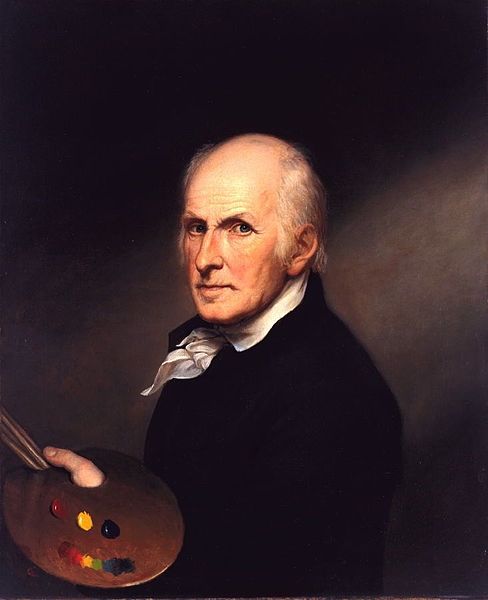
Charles Willson Peale "Self portrait"
Image: Wikimedia Commons

These "Overmountain Men" of the upper Tennessee settlements were highly revered, and John Sevier was among the most celebrated of those heroes. Sevier's exploits in Tennessee's wilderness were legendary. He was well-known as an Indian fighter and land speculator before becoming the first Governor of Tennessee. Most first generation frontiersmen had little time to sit for portrait artists, but by the time John Sevier sat for Peale's portrait he had long since left the frontier way of life. He was a military war hero and a statesman, an image well-suited for Peale's documentary of the new republic, and an image that endured throughout John Sevier's political career.

Of course there were no cameras in John Sevier's time to capture images of his exploits, so Charles Willson Peale's stately military portrait of John Sevier ultimately became the visual memory of his accomplishments as a Revolutionary War veteran. Today, John Sevier is remembered as "Pioneer, Soldier, Statesman" due in no small measure to the brushstrokes of America's most famous artistic biographer, Charles Willson Peale.


SOURCES:

  • Charles Coleman Sellers, Charles Willson Peale Portraits and Miniatures (Phila. 1962), pp. 16-17.
  • Ann Toplovich and F. Lynne Bachleda, "Preserving Our Stories: 150 Years of the Tennessee Historical Society," Tennessee Historical Quarterly, Volume LVIII, Number 3 (Fall 1999), 225-226.
  • "Portrait Painting in Tennessee," Tennessee Historical Quarterly, Volume XLVI, Number 4 (Winter 1987).


Gordon Belt is an information professional, archives advocate, public historian, and author of The History Press book, John Sevier: Tennessee's First Hero, which examines the life of Tennessee's first governor, John Sevier, through the lens of history and memory. On The Posterity Project, Gordon offers reflections on archives, public history, and memory from his home state of Tennessee.