Showing posts with label Joseph Martin. Show all posts

Polygamy on the Early Tennessee Frontier

Last week, I had the opportunity to listen to Cumberland University professor Dr. Natalie Inman as she delivered a thought-provoking lecture to members of the Tennessee Historical Society at the Fort Negley Visitor's Center. Her presentation, "Polygamy in the Early Republic: The Case of Indian Agent Joseph Martin," not only covered Martin's wildly fascinating married life -- he had 23 children with four different wives, white and Cherokee -- but also examined the polygamist culture that existed on the Tennessee frontier.

According to Dr. Inman, intermarriage between white settlers and Native Americans became a necessary survival tactic on America's new frontier. Inman argued that white men needed Cherokee wives to conduct business on the frontier as a means of cross-cultural cooperation. Cherokee culture embraced a maternally-focused family structure, unlike Euro-American cultures which were inherently paternalistic. Within the Cherokee family structure women held far more power than men. Recognizing this, white men often married Cherokee wives not for love, but rather in order to acquire land or negotiate trade routes. Inman argued that Indian Agents, like Martin, used marriage as a negotiating tactic in diplomatic relations, and though frowned upon in America's Euro-centric culture, both intermarriage and adultery were accepted norms on America's early frontier.

The acquisition of land was a frequent ambition of white settlers of "THE CHEROKEE COUNTRY," and white men often relinquished control to women in the maternalistic Cherokee culture in order to obtain land rights and diplomatic leverage in trade negotiations. 
Image credit: The Project Gutenberg eBook of Myths of the Cherokee, by James Mooney, 1900.


Inman also discussed the rivalry that existed between Martin and John Sevier, a topic I briefly explored on The Posterity Project a few months ago. Martin's position as an agent and superintendent of Cherokee Indian affairs put him squarely at odds with Sevier, who saw the Cherokees as a threat to establishing sovereignty for his fragile State of Franklin movement. During her talk, Inman described Martin as a "warrior" who protected his Cherokee family against Sevier's unnecessary aggression, while he simultaneously sought protection for his white family during the State of Franklin conflict. According to Inman, hard times created more complex household structures, and on the American frontier, complex families, like Martin's, were more common than one might expect.


Questions about John Sevier's own married past...


As a public historian, I make my living, in part, by seeking the truth about our collective past. In my ongoing blog series about John Sevier, and in my book, John Sevier: Tennessee's First Hero, I have frequently challenged long-held traditions and beliefs in search for the truth. Sometimes, this quest for truth leads me down elusive paths.

One of the unanswered questions that I occasionally receive from readers concerns Sevier's descendants -- more specifically his relationship with the indigenous Cherokee population of Tennessee, and rumors of an alleged affair Sevier had with an unknown Cherokee woman. Whispers of this rumor can be found on various online publications and genealogy forums, but finding credible primary and secondary published sources to back up those online claims has proved challenging.

One article published online and shared widely among family history researchers asserted, "several families claim a lineage to John Sevier and an unknown Cherokee Indian woman. Their daughter, Winney Alice Sevier, was left by her mother in Russell County, Virginia, at the Henry Campbell farm. Winney later fell in love with Campbell’s son, Abraham, whom she married and lived with in a home on the adjacent farm." The article, no longer available online, borrowed liberally from previously published narratives of Sevier's life without attribution, and so I hesitate to give much weight to this assertion.

A more credible source shared by a reader of this blog recalled the story of "Ann Eliza Carter." Anna Eliza was born Nov. 17, 1825, the daughter of William Carter and Lucindia Sevier. In her book, Notable Southern Families, Volume IV: The Sevier Family, buried in a reference to Lucindia Sevier's lineage, Zella Armstrong wrote that as a young girl Ann Eliza recalled that "she knew very little of her ancestry, but was told she was a grand-daughter of Governor John Sevier." Armstrong chronicled young Ann Eliza's memories of her family history stating, "She remembers that in her childhood, an old lady lived at her home who was called Aunt Winnie Sevier. She does not know whether this was her deceased mother's sister or aunt." No mention of Cherokee ancestry here, but with only vague recollections about Winnie(ey) Sevier's lineage the speculation persists.

Another name recently surfaced in my email correspondence with Sevier descendants. Obedience Hillard Sevier is a name cited on genealogy message boards as someone with a familial connection to Sevier. Some allege that Sevier fathered Obedience with a Cherokee mistress, while others state that Obedience was an indentured servant to the Sevier family who took on her master's name. Still others claim there was likely no relation to Sevier whatsoever, and the connection is based purely on myth and misinformation. The latter claim seems more plausible to me, but after hearing Dr. Inman's lecture, I do wonder... Did Sevier engage in his own "diplomatic" relations with the Cherokees in the same ways as his enemy, Joseph Martin? It's not an unreasonable question given the long history of this practice on the early frontier, but a lack of definitive historical evidence in this case makes proving the connection difficult, if not impossible. It's a question we may never fully answer.


A thought-provoking question...


I want to clearly state that I am not a professional genealogist, and my book is not a genealogy of the Sevier family. John Sevier: Tennessee's First Hero examines Sevier's life within the context of history and memory. It is not a Sevier family history. Still, I have extensively researched Sevier's life, with particular attention to his military campaigns against the Cherokees.

I have yet to encounter a credible source that definitively proves a familial link to Sevier and the mysterious Cherokee children sharing his surname, and I certainly cannot project the actions of those like Martin onto Sevier. Yet questions about Sevier's alleged affair with a Cherokee mistress remain unanswered. This is a topic that I'm sure some will find provoking, but one that I hope will challenge us all to examine the past, "warts and all."


Gordon Belt is an information professional, archives advocate, public historian, and author of The History Press book, John Sevier: Tennessee's First Hero, which examines the life of Tennessee's first governor, John Sevier, through the lens of history and memory. On The Posterity Project, Gordon offers reflections on archives, public history, and memory from his home state of Tennessee.

Joseph Martin versus John Sevier

   As I began compiling research notes for my book, John Sevier: Tennessee's First Hero, I came to know some colorful characters who interacted with Sevier as he established his reputation as a leader among the nation's earliest pioneers. One character that captured my attention during this period of writing and research was Joseph Martin.

   As a longrifleman, frontiersman, soldier, Indian agent, and legislator, Joseph Martin occupied an important role in the settlement of the Trans-Appalachian West. He established the only station between the start of the Wilderness Road in Virginia and Crab Orchard on the edge of the Kentucky settlement and defended the station from attacks by the Cherokees, allowing settlers safe passage through the Cumberland Gap. In 1777, Virginia Governor Patrick Henry appointed Martin as an agent and superintendent of Cherokee Indian affairs. In this role, he took up residence with the native population and negotiated periods of peace between advancing settlers and the established Cherokee Nation. In 1780, Martin famously kept the Cherokees at peace as John Sevier and his Overmountain Men assembled a frontier army to defeat British Major Patrick Ferguson's Torries at the Battle of King's Mountain.

Portrait of General Joseph Martin (1740–1808)
of the Continental Army.
Image credit: Wikimedia Commons
   From childhood through adolescence and into adulthood, Martin charted an unconventional path through the wilderness. Born of an affluent family near Charlottesville, Virginia in 1740, as a young boy, Martin set out on his own. Martin and his childhood friend Thomas Sumter, ran away from home seeking a life of adventure. As a young man, he developed natural instincts as a pioneer and explorer, spending six to eight months out of the year on the extreme frontier hunting and trading for peltry among the Indians. Although he commanded a company against the Cherokees in several engagements, he remained among the tribes once peace had been settled. He even married the niece of Nancy Ward, the "Beloved Woman of the Cherokees" and a respected negotiator in her own right.

   Although Martin served in his role as peacemaker with honor and distinction, a few nineteenth century chroniclers of early American history questioned Martin's loyalties. Through their writings they revealed a suspicion felt by some of John Sevier's loyal followers toward General Joseph Martin.

   One particular episode documented by these early historians bears witness to this mistrust, as Sevier rallied his fellow citizens in 1784 to establish an independent State of Franklin. Martin's loyalties were devoted to the parent state of North Carolina, and his election as brigadier-general of the militia of Washington District placed him into direct conflict with Franklin's elected leader. Over the course of four years, Franklin remained bitterly divided and governed in chaos by dueling authorities. By July of 1788, North Carolina Governor Samuel Johnston ordered Martin to arrest Sevier for treason and encroachment on Indian lands, which further inflamed Sevier's loyal followers.

   The late-nineteenth century North Carolina historian Stephen Beauregard Weeks recorded an incident that took place during this period of unrest. Weeks described a scene that rightfully belongs in a movie script. According to the respected scholar, Sevier's followers attempted to assassinate Martin in a preemptive strike against the frontier diplomat. In his biographical essay, "General Joseph Martin and the War of the Revolution in the West," Weeks wrote:

   "The efforts of Martin to protect the rights of the Indians brought down the wrath of the Sevier party upon him, and in this generation that of Sevier’s worshipers. These men, short-sighted and incapable of seeing the question in its broader relations, said that Martin was a friend to the Indians and therefore no better than they. So a party of some fifty men gathered and traveled some 30 miles with the intention of killing him. When they reached the Holston they halted and sent eight or ten forward to reconnoiter. Col. Martin had in the meantime learned their purpose. He went out to meet them heavily armed, demanded their business, and said he would shoot down the first man who moved his gun. They protested that they had no hostile intentions. He finally invited them into the house; they went in and drank, sent for their comrades who had been left behind, and the whole affair, owing to his courage and presence of mind, ended in a frolic instead of a tragedy."

   "I have no idea that Sevier was in any way responsible for this attempt, but Martin’s firmness in the matter of Franklin, plus the fact that they represented opposite sides on the question of Indian encroachments, widened the breach that had already begun between these two patriots and which seems to have continued through the remainder of their career. This hostility was not peculiar to Martin and Sevier by any means. All of these leaders, as Roosevelt points out, show more or less of the same spirit, and it was a natural one. There seems to have been no hard feeling on Martin’s part. He writes Sevier in October, 1788, and says: ‘Our Interest are or ought to be so jointly Concerned that the strictest friendship Should Subsist, which is my Earnest Desire.’ But this was not the case and the charges of conspiracy which Sevier propagated kept them apart."

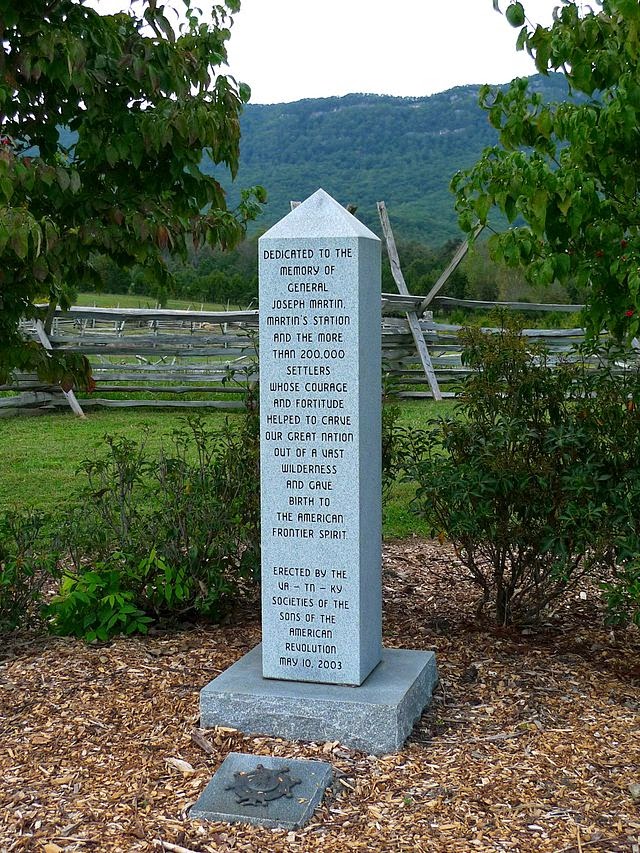
Memorial to General Joseph Martin
and settlers at Martin's Station, Virginia.
Image credit: Wikimedia Commons
    Weeks' anecdote revealed one of the most bitter rivalries that existed on America's first frontier. While Martin respected Sevier and sought his friendship, even against ten-to-one odds, he held no fear of "Nolichucky Jack" or his followers.

   Joseph Martin died in 1808 in relative obscurity. Despite his reputation as a diplomat and keen negotiator, coupled with his honorable service as a soldier and legislator, posterity neglected to preserve the memory of Martin's accomplishments. Martin's close ties with the Cherokees led many of his compatriots to mistrust him, and over time, Sevier's legend overshadowed Martin in the annals of history.

   Long after his death, the nineteenth-century antiquarian Lyman Draper attempted to resurrect Martin's reputation by establishing a friendship and correspondence with Martin's son, William, a pioneer in his own right. Draper's exchange of letters with Colonel William Martin documented both Joseph Martin's own life and the congenial bond formed between the son of this early frontiersman and the eager young historian.

   Draper, a prolific collector of manuscripts and gifted interviewer, never published his planned series of biographies of the border heroes he idolized, and thus Joseph Martin eluded public memory. His legacy remained buried within the pages of history as merely a footnote to the larger narrative devoted to the celebrated and revered John Sevier and his fellow Overmountain Men.


SELECTED SOURCES:

  • Stephen Beauregard Weeks. "General Joseph Martin and the War of the Revolution in the West." American Historical Association. Annual Report for the year 1893. Washington, 1894.
  • "Joseph Martin" in Biographical History of North Carolina From Colonial Times to the Present, Volume II, pp. 240-249. 
  • William Allen Pusey. "The Location of Martin's Station, Virginia." Mississippi Valley Historical Review. Vol. 15, No. 3, Dec., 1928.
  • Josephine L. Harper. Guide to the Draper Manuscripts. Madison: State Historical Society of Wisconsin, 1983, pp. 215-216. 


Gordon Belt is an information professional, archives advocate, public historian, and author of The History Press book, John Sevier: Tennessee's First Hero, which examines the life of Tennessee's first governor, John Sevier, through the lens of history and memory. On The Posterity Project, Gordon offers reflections on archives, public history, and memory from his home state of Tennessee.